When Robbie Antonio started Antonio Development in New York City, he did so with a bold idea: a collaboration with Pei Partnership on what would become the architect’s only homegrown residential project. That idea took shape in The Centurion, a boutique limestone tower in Midtown Manhattan.For Antonio, it wasn’t just a career milestone. It was a design education, a crash course in timeless execution, and the start of a lifelong conviction: that architecture and business can be fused to create lasting value.
More than a decade later, Antonio has set up a private family office, and the same design-first, strategy-aligned mindset is visible across these future ventures. What began as a developer’s instinct has matured into a more holistic approach to investing, branding, and scaling across industries.
A Philosophy becomes a platform
The Centurion, completed in 2008, was a formative project. Its precise geometry, clean lines, and restrained luxury reflected Pei’s philosophy: that good design is not about spectacle, but permanence. Antonio, then a first-time developer, led the site assembly and execution, working closely with I.M. Pei and his son, Sandi.
A major factor in making the collaboration possible was Century Properties founder Ambassador Jose E.B. Antonio, whose longstanding relationship with I.M. Pei helped pave the way. Even after his retirement, I.M PEI returned to play a key role in both The Centurion and the Qatar Museum projects, at the request of Ambassador Antonio.
That early success wasn’t just about location. It was about differentiation; the kind that comes from choosing collaborators carefully, managing details rigorously, and designing with intent.
Today, those same principles guide how the private family office will operate. While the group has grown far beyond its real estate roots, its current projects carry echoes of that original DNA.
Building with clarity, to stand the test of time
Across all of these initiatives, a pattern emerges: bold partnerships, disciplined execution, and a belief in long-term value over short-term hype.
“There are easier ways to build,” Antonio says. “But I’ve seen what happens when you start with clarity. When you work with people at the top of their field, and design something that can stand the test of time.”
That clarity now defines the private family office’s edge. It isn’t just about luxury towers or big-name collaborators. It’s about using design and brand credibility not as decorations but as levers for serious value creation. For Antonio, the Pei partnership wasn’t just a collaboration; it was a model of how principle and performance can coexist.
“The Centurion taught me that great design is quiet,” Antonio reflects. “It doesn’t need to scream. It just needs to last.”
Long before Robbie Antonio took the reins of the Jose Antonio Group Inc. or JAGI — now the Antonio family’s consolidated private investment vehicle — he was already making waves for forging bold, high-profile collaborations in luxury real estate. Among the most talked-about projects is his partnership with Italian fashion icon Giorgio Armani.
The project is Century Spire, a 60-story tower in Makati’s Century City completed in 2022. Designed by star architect Daniel Libeskind and outfitted by Armani/Casa Interior Design Studio, the skyscraper embodied Antonio’s vision of elevating Philippine real estate to world-class stature. Armani’s studio was tapped to curate not just the interiors of the private residences but also the shared spaces — down to the lobbies, pool lounge, and library. The result was a seamless blend of design, fashion, and function.
Luxury and innovation
Robbie Antonio with Roberta and Giorgio Armani
Now, as CEO of JAGI, Antonio is taking that same mindset to a broader playing field. While real estate remains part of the equation, JAGI’s portfolio has expanded to include healthcare, fintech, technology, and consumer goods. The group’s mission is to back ideas that create long-term impact and push boundaries.
“The Armani collaboration showed us what’s possible when you mix visionary design with strategic ambition,” Antonio said. “That level of creativity and precision is something we want to bring into all our investments — not just buildings, but brands, platforms, and people.”
Long-lasting influence
Antonio’s focus on the family office, Jose Antonio Group Inc. (JAGI), isn’t a departure from his roots, but a continuation of the ethos that made his projects stand out from the start. Where others saw buildings, he saw experiences. Where others stuck to tradition, he courted change-makers.
Century Spire may be complete, but its influence remains. It’s a case study for what happens when Filipino development is unafraid to engage global talent. And as JAGI looks ahead, it’s clear that partnerships like Armani/Casa weren’t just for show, but were proof-of-concept.
From branded towers to cross-sector investments, Antonio is steering JAGI with the same daring that first caught the world’s attention. If the Armani collaboration marked a high point in Philippine luxury real estate, it also laid the groundwork for a future that’s more agile, ambitious, and globally minded.
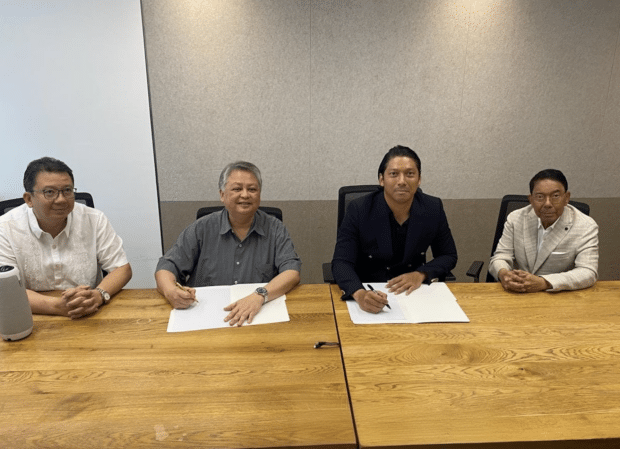
Jose Antonio Group Inc. today announced a groundbreaking strategic partnership to deploy Starlink and add-on value-added services—executed in collaboration with iWave—to bring advanced satellite broadband connectivity to underserved regions across the Philippines.
From left to right: President and CEO of iWave, Ramon C. Garcia Jr., Executive Director and COO of iWave, Marco R. Urera, CEO of Jose Antonio Group Inc., Robbie Antonio, and Philippine Ambassador-at-large and Chairman of Jose Antonio Group Inc., Jose Eduardo Antonio.
This initiative marks a significant step in the company’s digital transformation strategy, leveraging its 40 years of experience and a robust network of affiliate companies to empower communities with reliable, value-added services layered over high-speed internet connectivity.
“Our partnership with iWave using Starlink Connectivity is a game-changer in our efforts to bridge the digital divide in the Philippines,” said Robbie Antonio, CEO of Jose Antonio Group Inc. “By combining our extensive industry expertise with Starlink’s innovative satellite technology and iWave’s local digital solutions, we aim to deliver transformative broadband services that support education, healthcare, and economic development in even the most remote areas.”
The collaboration will harness Starlink’s state-of-the-art satellite network to extend reliable digital solutions, platforms, and value-added services via the high-speed connectivity to regions lacking traditional internet infrastructure. This venture is designed to create lasting impact, driving sustainable growth and fostering a more inclusive, technology-driven future for the Philippines.
“We are excited about the long-term potential of this initiative,” added Antonio. “Our combined approach will enable us to catalyze transformative digital solutions that not only empower communities but also contribute to the country’s overall economic and social development.”
ADVT.
This article is brought to you by Jose Antonio Group Inc.
Palawan, often hailed as the crown jewel of Philippine tourism, is poised for a new era of sustainable and strategic development. Leading family-led investment firm Jose Antonio Group Inc. (JAGI), renowned for its expertise in high-end, world-class developments, has hinted at a transformative project that will embrace Palawan’s natural splendor while further elevating its global stature.
“Our vision is to contribute meaningfully to Palawan’s standing as a premier destination – one that remains pristine, yet continues to evolve as a benchmark for sustainable tourism and investment,” said Robbie Antonio, CEO of Jose Antonio Group Inc.. “We are exploring opportunities that will preserve and celebrate Palawan’s ecological and cultural wealth while introducing world-class standards in luxury and responsible development.”
While details remain under wraps, the planned venture is expected to include a carefully curated mixed-use blueprint with an emphasis on exclusivity, sustainability, and premium lifestyle experiences. In contrast to mass tourism-driven developments in destinations such as Bali and Phuket – where concerns over environmental degradation have intensified – Jose Antonio Group Inc. aims to demonstrate a model for responsible growth that enhances, rather than overwhelms, the local scene.
Rich biodiversity, authentic culture
Palawan’s unparalleled natural beauty, from its vibrant coral reefs and extensive mangrove forests to its indigenous communities and rich biodiversity, makes it a rare gem in global tourism. The firm recognizes that the province’s long-standing reputation as an ecological sanctuary must remain at the heart of its evolution. The firm’s approach will align with sustainable, high-value tourism, ensuring that any development harmonizes with its surroundings, benefits local communities, and strengthens the Philippines’ positioning as a world-class tourism and investment hub.
For over three decades, the Antonio family has built a legacy of pioneering high-end, globally recognized developments, working with some of the most esteemed names in design and architecture. Their latest endeavor in Palawan promises not just an expansion of this portfolio, but a commitment to raising the profile of Philippine tourism and investment on the world stage.
“Palawan deserves a place among the most sought-after global destinations, and we see an opportunity to reinforce its prestige responsibly,” Antonio added. “This will be more than a development, but a statement on how growth and conservation can go hand in hand.”
As Jose Antonio Group Inc. finalizes its vision for Palawan, the firm remains engaged in extensive research and consultation to ensure that its approach aligns with environmental best practices, local stakeholder interests, and the long-term viability of the region. More details are expected to be unveiled in the coming months.
ADVT.
This article is brought to you by One Person Corporation.
Philippine Ambassador-at-Large Jose Eduardo B. Antonio, alongside his wife Hilda Antonio and son Robbie Antonio, joined world leaders, dignitaries, and close friends of the Trump family at the inauguration of Donald J. Trump as the 47th President of the United States.
Coming off the New Year’s celebration at Mar-a-Lago – often referred to as the ‘Second White House’ – the Antonio family attended a series of exclusive inaugural events, including the prestigious inaugural ball where President Trump and the First Lady made their traditional dance.
Ambassador Antonio, appointed by President Ferdinand Marcos Jr. as the Philippines’ Special Envoy with a global scope, engaged in high-level discussions with key world officials and business leaders centered on promoting foreign investments in the Philippines and exploring new avenues for bilateral trade.
“We are entering a pivotal era in global trade, where the U.S.-Philippine relationship holds immense potential,” Ambassador Antonio shared. “As the U.S. leads in this new technological age, the Philippines brings to the table a vibrant innovation community and a young, tech-savvy workforce already now engaged in higher-value industries. Strengthening these ties will not only drive mutual economic growth but also create new opportunities for the Filipino people in the global marketplace.”
The Trumps and the Antonio’s: A legacy of friendship and diplomacy
Robbie Antonio CEO of Jose Antonio Group Inc.
The Antonio’s and the Trumps have been long-time friends and business partners. For Robbie Antonio, who originally brought the Trump business relationship and the families together, this marked his sixth attendance at the Mar-a-lago New Year’s event with the U.S. First Family and second U.S. presidential inauguration – first for the 45th, and now for the 47th President of the United States.
Speaking about the family’s attendance, Robbie Antonio said: “Our family has cherished a long-standing friendship with the Trumps, and being present at this historic moment was both a personal honor and a reflection of the strong ties.”
PHL’s trusted, Go-To guy for trade relations
“As Special Envoy, I have always prioritized the Philippines in every diplomatic conversation. From my role as Special Trade Envoy to China in 2005 to my appointment as Special Envoy to the United States in 2016, my mission has remained clear—creating opportunities that benefit the Filipino people,” said Ambassador Jose E.B. Antonio
Jose E.B Antonio Ambassador
With a distinguished diplomatic career spanning multiple administrations, Ambassador Jose E.B. Antonio has long been the country’s trusted representative in critical trade discussions. He served as the Philippines’ Special Trade Envoy to China in 2005 during the Arroyo administration, followed by his appointment as Special Envoy to the United States in 2016 under President Duterte during President Trump’s first term.
ADVT.
This article is brought to you by the Department of Foreign Affairs.
The government has partnered with a $1-billion local company in a bid to turn the country into a leader in prefabricated houses.
The partnership was sealed on Friday between the Department of Science and Technology (DOST) and the private firm Revolution Precrafted which aims to develop new technology that would make the Philippines a hub for prefabricated houses, especially in Southeast Asia.
Carlos Primo David, executive director of the DOST’s Philippine Council for Industry, Energy and Emerging Technology Research and Development, said since Revolution is a Filipino brand, science officials want to help provide the technological know-how in the prefab industry that would bring not only economic benefits, but also “create a positive societal impact.”
David said Revolution may yet disrupt “the entire construction and housing industry” in a positive way so DOST researchers “would figure out what we can do and how we can help.”
Global brand
“We want this global brand to be truly Filipino, not only in terms of concept but also in the materials used and the research and development that go with it,” David said.
Founded by Robbie Antonio in 2015, Revolution is the Philippines’ first unicorn startup, which means that it was already valued at over $1 billion. The company specializes in providing prefabricated designer houses that can be shipped to anywhere in the world in 90 days.
Despite the company’s achievements, David said there’s still room to grow for the prefab industry, like materials that can be used for prefab, low-cost houses.
New products
Research on these materials are essential to Revolution, according to Antonio. He said his company is looking at how to help the government rebuild communities ruined by storms, like Tacloban City, or wars, like Marawi City, with the use of prefab technology.
In the coming months, David said the DOST would either fund or cofund projects to create products which the industry could use. One of the projects in the pipeline is the curved fiber cement board that is currently available only in straight slabs in the market.
Asked about Revolution’s plans since it currently gets its materials from India and Malaysia, Antonio said the company would soon put up a plant in the Philippines which would use technology developed by DOST scientists and university researchers.
With the help of the DOST, Antonio said his company hopes to build a “plant that is so advanced.”
David said although the Philippines “missed the boat for so many technologies in the past,” the DOST was making sure it was part of Revolution’s concept.
He, however, warned of imitation products in the future. “If this catches on, there would be copycats everywhere. Since this is a Filipino brand let’s do our part to protect it,” David said.
The game changer is here. Century Properties Group, the real-estate company behind some of the most exciting and revolutionary developments seen on Philippine soil—Gramercy Residences (a hyperamenitized and fully serviced luxury residence), Azure Urban Resort Residences (featuring the country’s first man-made beach and beach club designed by Paris Hilton), Acqua Livingstone interior design by MISSONIHOME, Acqua Iguazu yoo inspired by Philippe Starck, the Milano Residences interior design by Versace Home, Trump Tower Philippines, Century Spire by architect Daniel Libeskind and interior design by Armani/Casa—is once again poised to change the industry, this time with its first tourism-oriented development featuring modern designer homes and world-class amenities set against lush surroundings.
With over 30 years of experience in the Philippine real-estate industry, Century Properties Group presents its most ingenious, avant-garde project yet—Batulao Artscapes, a 142-ha project dubbed as the world’s first “livable art park,” and for very good reasons.
Featuring Revolution Precrafted designer homes, themselves intriguing works of art, the development will have an art park and four museums designed by Pritzker Prize awardwinning architects.
ButterflyHome by Elizabeth de Portzamparc: The ButterflyHome reflects all the fundamental elements of Elizabeth’swork, such as flexibility, modularity,lightness and movement—all of which are introduced in this project through inclined shapes.
Batulao Artscapes will attract active retirees with its relatively cool climate and state-of-the-art amenities—there’s a man-made beach, lake and floating chapel, a sports and kids park, among many others—and proximity to Metro Manila’s financial district. It’s only a 1.5 to 2-hour drive from Makati via four access points: through Daang Hari Road toward the scenic Nasugbu-Kaybiang Tunnel, the Star Tollway to Tanauan Exit, the South Luzon Expressway (SLEX), and Cavite Expressway (Cavitex).
(Once the 49-km Cavite-Tagaytay-Batangas Expressway or CTBEX is built, travel time to nearby Tagaytay City will only take less than an hour, as announced by the tollways unit of Metro Pacific Investments Corp. Construction of the proposed CTBEX is expected to start by the 1st half of 2019.)
We Home by AFGH: The interiors and exteriors of the structure are true to the aesthetic of AFGH—fully adaptive and customizable
Live surrounded by wonderful works of art, as the bustling community will also feature museums by these design masters, replete with village-exclusive amenities, as well as a stunning, man-made lake and beach. The museums are a sight to behold, designed by Christian de Portzamparc for the Revolution Museum of Design and Architecture, Jean Nouvel Design for the Revolution Museum of Visual Arts, Philip Johnson Alan Ritchie Architects for the Revolution Museum of Art and Technology, and Tange Associates for the Revolution Museum of Performing Arts.
Batulao Artscapes will also have casual and formal dining options, as well as venue space for festivals and fairs. Batulao Artscapes will be a mix of the best of both nature and city conveniences by promoting a pedestrian culture and cultivating an eco-conscious, sustainable, suburban way of life.
While remaining respectful of the natural terrain, the concept of this neo-residential community is based on four core components: Active, Meditative, Festive, and Creative individuals.
Man-made beach
Active is represented in sports and outdoor activities—there are bike and hike trails, a man-made beach for swimming, a sports park, and “artventure” park; Meditative is for the spa, health, and wellness facilities, with a man-made lake for kayaking and boating, a clubhouse for yoga and a spa, and lots of open parks.
Festive is for the food concepts, festivities and themed celebrations, with the Flavor Park for fresh F&B concepts, Artventure Park Green House Pavilion, the Revolution Museum for Performing Arts, and a floating chapel; and Creative is for featuring art and design in all designer homes, art park with designer pavilions, and the four museums.
With its pedestrian-friendly culture, world-class amenities, and proximity to Metro Manila’s financial district, Batulao Artscapes aims to attract active retirees and become the vacation destination of a vibrant, active retirement community, or foreign retiree members 35 years old and above who wish to retire and live in the Philippines.
Billboard Home by David Salle
With this in mind, Batulao Artscapes will have Centuria Medical Urgent Care with Ambulance, a dedicated medical facility for urgent health needs; a transport hub to assist in transportation in and out of Batulao Artscapes, lay-by for bus stops, and roving e-jeeps within the development; dormitories to accommodate household staff for an overnight stay or longer; and Siglo Suites, premium hospitality and leasing management services for clients who wish to enroll their units for leasing.
Even more good news, Batulao Artscapes can assist foreign nationals and/or former Filipino citizens in their application for a Special Resident Retiree’s Visa with the Philippine Retirement Authority. The SRRV comes with additional benefits, including medical insurance for a set period of time.
Libeskind Design’s Adaptation Home II is a homage to the simple joy of living.
Established architects
Imagine owning a home designed by some of the world’s most eminent architects and award-winning firms and design collectives, such as Philip Johnson Alan Ritchie Architects, Marmol Radziner with Kravitz Design, Libeskind Design, Jean Nouvel, Paulo Mendes de Rocha, Daphne Guinness, and many more. Even the Dutch product and interior designer Marcel Wanders, who achieved international recognition with his Knotted Chair in 1996, designed his first home for Revolution Precrafted and it can be yours in Batulao Artscapes.
Notable Filipino architecture and design names Kenneth Cobonpue, Budji Layug and Royal Pineda through Budji+Royal Architecture + Design, and Eduardo Calma are also featuring their designer homes here.
Batulao Artscapes is set to be a cultural landmark in Southeast Asia, offering a mix of sports and art parks by fostering a design-driven community in an expansive natural landscape.
These structures will be built using a combination of conventional construction methods and prefabrication, and will offer different sizes and specifications in order to meet individual tastes and preferences.
Daphne SkinHome by Daphne Guinness: The Daphne SkinHome is a “fashion” house that reflects the style of Daphne Guinness. Borne from the creativity of a fashion designer, artist and theater enthusiast, Daphne’s SkinHome is a work that evokes drama and sophistication.Eden by MarcelWanders. Wanders is a product and interior designer, an art directorwho won global recognition with his iconic Knotted Chair in 1996.BUDJI+ROYAL’s The Facet affords the homeowner numerous configuration possibilities through the use of practical and functional design attachments.HEDERA by Kenneth Cobonpue: Nature is an essential part of us, asmuch aswe are a part of it. Serving as the organic architect, nature actively participates in the design process as evergreen shrouds the walls, turning the artificial structure into a soft and lush sight to behold.Instrumental Home by Marmol Radziner for architecture/Interiors by Kravitz DesignThe Modular Glass House by Philip Johnson/Alan Ritchie ArchitectsTranche by BUDJI+ROYAL: Tranche is a unique home model that grows and expands in tranches as it takes into account the evolution of one’s lifestyle.Revolution Museums and the Kids ParkRetail area: The Flavor ParkSports Park
Visit http://www.batulaoartscapes.com for more info.
Antonio discusses the merits of Revolution Precrafted with model and actress Kate Upton
The peripatetic Robbie Antonio is a man in a hurry, driven hard by his lofty ambition to make Revolution Precrafted, reputedly the world’s only branded housing company, the country’s first “unicorn” or startup firm valued at over $1 billion.
And Antonio, who maximizes every second of his waking hours, believes he is on his way to achieving that goal, with his brainchild valued at some $256 million as of March 2017, just a little over a year since it was established to shake up the real estate industry, not just in the Philippines but around the world.
Antonio has intimate knowledge of the ever-dynamic real estate industry having grown up with it, being one of the four sons of Century Properties Group Inc. founder Jose E.B. Antonio.
“It is not like I just woke up in this industry. It is one that I know very well,” says the 40-year-old Antonio, who remains responsible for the resort and tourism side of the Century Properties portfolio.
Thus, Antonio also knows the pain points and the massive opportunities that Revolution Precrafted can take advantage of.
Revolution Precrafted basically supplies the market with prefabricated structures such as modular homes, condominiums and pop-up retail stores and fitness centers that bear the names of some of the world’s top names in design and architecture.
Its greatest assets are ownership of the intellectual property of world-class designers, the global network of fabricators and the invaluable relationships with developers and landowners.
For Antonio, Revolution Precrafted is defined by five key points—speed, quality, technology, designer brands and global.
Through its ties with quality fabricators here and abroad, for instance, it can complete the developments faster. A 50-square-meter home can be done in as fast as three months as opposed to the usual two years since most of the components had already been fabricated, ready for assembly at the job site.
Then instead of wasting six months to a year on the design, clients of Revolution Precrafted can choose from the works of such award-winning architects as Zaha Hadid, Jean Nouvel, Christian de Portzamparc and Paulo Mendes de Rocha and celebrities like Tom Dixon, Lenny Kravitz and Daphne Guinness.
Revolution Precrafted thus democratizes access to branded design of living spaces by combining world-renowned designers with the latest advances in construction technology.
Clients can boast of living in a home designed by actor and singer Lenny Kravitz without having to pay the full cost but getting all of the benefits, in terms of speed, quality and branding.
The self-confessed deal junkie was able to get these designers and fabricators to believe in the mission of Revolution Precrafted because they were piqued by the challenge posed by the startup to help shake up the real estate industry, the same way that Grab and Uber revolutionized the transport industry and Airbnb forever changed the hospitality sector.
Antonio’s passion for Revolution Precrafted is indeed infectious and venture capital firms have been quick to jump on the concept.
Early on, Antonio was able to raise seed funding from 500 Startups, the world’s most prolific venture capital firm, and more are expected to follow suit as the company flexes its muscles in the Philippines and in other countries in Asia and strengthens ties with real estate developers who want to deliver projects as quickly and as cost-efficiently as possible.
“Our mission is to be the biggest home supplier in the world,” says Antonio, “And I would love to put the Philippines on the technology scene.”
Revolution has teamed up with some of Hollywood’s best to design one-of-a-kind structures .
The movers and shakers of the real estate industry over the past couple of decades have predominantly been architects and designers, whose wealth of experience has borne iconic structures.
Recently design and art has begun to intersect with other disciplines. Art, design, architecture, and fashion are all means for self-expression, fashion being the closest and most personal of them all.
It does not come as a surprise that celebrities, musicians, style and fashion icons, gravitate towards expressing their craft through different mediums—from furniture to product design, interior design, as well as architecture.
These people are among those whom Revolution Precrafted is collaborating with.
Founded by Robbie Antonio, Revolution Precrafted plays a role in the emergence of this new breed of designers and starchitects, by acting as a platform for artistic collaboration.
“We are very particular about choosing the brands that we work with, and this has been one of the most exciting aspects of the business. Searching for, collaborating with, and producing structures designed by the best minds in the world, is what drives us at the company,” Antonio said.
To date, Revolution has gathered over 61 of the world’s leading architects and designers to design one-of-a-kind structures exclusively for Revolution. Belonging to this formidable lineup of industry thought leaders are creatives from Hollywood’s glitterati and fashion icons.
Kravitz Design
Kravitz Design Inc. was founded by legendary music icon Lenny Kravitz. Focusing on residential, commercial, and product design, the firm touts a portfolio of noteworthy ventures.
Working with Revolution allowed him to channel his vibe into a house that is sensual and tough at the same time.
The Instrumental Home, a collaboration between his firm and Marmol Radziner, carries a smooth and masculine design. The dark grey finish and modern cabin-esque walls of the facade continues into the interiors creating a sinewy silhouette, while the overall monolith shape of the single-storey structure evokes a muscular allure.
STÆRK&CHRISTENSEN
Design duo Camilla Stærk and Helena Christensen are the brains behind STÆRK&CHRISTENSEN, a New York-based studio with a reputation for holistic work across the fields of fashion, interior design, furniture, photography, and film.
The marriage of Stærk and Christensen’s individual styles and interests gave birth to an aesthetic rooted in a Danish design heritage and mid-century modern sensibility, mixed with gothic, mythical themes as well as the haunting glamour of old Hollywood.
Soon, Revolution will be launching a home, a spa pavilion, and fitness structure crafted by the veritable design duo.
Daphne Guinness
The British heiress is possibly one of the fashion and style world’s most inventive characters. She has been thought of as unique, enigmatic, and a true maverick. But Daphne’s unique perception of beauty and her skill for creatively expressing it is seen second to none.
Daphne dabbles in various artistic pursuits such as fashion, music, film, and even perfumery. Her curiosity and eye for beauty eventually led her to venture into architecture.
The Skin House is a “fashion” house that reflects the style of Daphne Guinness. The façade is composed of a series of fixed and collapsible metal panels. When the panels are closed, the house assumes the form of a metal box. When opened, the “sculpture” transforms into a house: doors and windows are revealed behind the panels.
Daphne’s house reflects her style: modern and classic. The polished concrete floor, red elements, and golden spiral staircase create vibrant interiors that match neoclassical design and modern finishes.
That, in a nutshell, is the mission of Filipino real-estate technology company Revolution Precrafted, which provides prefabricated property—pavilions, homes, condos, hotels—created by world-renowned architects at affordable prices.
“We try to really be a plug-and-play [real-estate] company that saves people a lot of time and brain power,” says Revolution’s CEO Robbie Antonio of Century Properties fame. “I [also] want to make design accessible to everyone, not just the wealthy. Zara was built on the idea that luxury design should be available to everyone, as was Ikea. Revolution Precrafted is the platform for this vision—in property.”
And it’s a vision that has caught the attention not just of other real estate companies—so far, Revolution has booked five development projects worth P26 billion, equivalent to 5,000 homes—but also venture capital and investment firms such as 500 Startups, which provided the company’s first round of funding, and Indonesia-based Bakrie Global Ventura, which signed a $1.1-billion joint venture agreement with Revolution during the recent Asean Summit.
“[500 Startups is] always looking for large industries whose value chain are fundamentally disrupted by a new business model—but it’s not always easy to find. Revolution represented the best of all of it; the property construction industry is as big as it gets, and their disruptive business model is real,” says Khailee Ng, 500 Startups managing partner.
Following the likes of “disruptive” companies such as Uber and AirBnB, Revolution Precrafted’s unique business model promises the best in architectural design combined with the latest in technological advancements in property development, such that it can finish projects at five times the speed of a traditional real-estate company and at nearly half the cost.
“There’s a plethora of developers all over the world and they do the same thing: They buy land, they build, they have different products. But I thought, if I’m going to create a different business line, it’s going to have to be extremely differentiated,” says Antonio. “I started looking at companies like AirBnB and Uber, and what they had in common was, No. 1, they’re global companies, they’re not pigeonholed into one region or country; No. 2, they don’t have any inventory. And they obviously use technology to disrupt.”
The company works exclusively with some of the world’s best architects as well as Pritzker Prize ones such as Zaha Hadid, Christian de Portzamparc, Paulo Mendes de Rocha and Jean Nouvel. Celebrity designers Tom Dixon, Lenny Kravitz and Daphne Guinness are also part of the company’s portfolio.
Revolution Precrafted provides the market prefabricated pavilions, homes, condos and hotels created by world-renowned architects at affordable prices.
Revolution Precrafted CEO Robbie Antonio—Arnold Almacen
To be the “Ikea of homebuilding.”
That, in a nutshell, is the mission of Filipino real-estate technology company Revolution Precrafted, which provides prefabricated property—pavilions, homes, condos, hotels—created by world-renowned architects at affordable prices.
ADVERTISEMENT
“We try to really be a plug-and-play [real-estate] company that saves people a lot of time and brain power,” says Revolution’s CEO Robbie Antonio of Century Properties fame. “I [also] want to make design accessible to everyone, not just the wealthy. Zara was built on the idea that luxury design should be available to everyone, as was Ikea. Revolution Precrafted is the platform for this vision—in property.”
And it’s a vision that has caught the attention not just of other real estate companies—so far, Revolution has booked five development projects worth P26 billion, equivalent to 5,000 homes—but also venture capital and investment firms such as 500 Startups, which provided the company’s first round of funding, and Indonesia-based Bakrie Global Ventura, which signed a $1.1-billion joint venture agreement with Revolution during the recent Asean Summit.
“[500 Startups is] always looking for large industries whose value chain are fundamentally disrupted by a new business model—but it’s not always easy to find. Revolution represented the best of all of it; the property construction industry is as big as it gets, and their disruptive business model is real,” says Khailee Ng, 500 Startups managing partner.
Following the likes of “disruptive” companies such as Uber and AirBnB, Revolution Precrafted’s unique business model promises the best in architectural design combined with the latest in technological advancements in property development, such that it can finish projects at five times the speed of a traditional real-estate company and at nearly half the cost.
Unmute
Duration 1:48
/
Current Time 0:46Advanced SettingsFullscreenPauseUp Next
“There’s a plethora of developers all over the world and they do the same thing: They buy land, they build, they have different products. But I thought, if I’m going to create a different business line, it’s going to have to be extremely differentiated,” says Antonio. “I started looking at companies like AirBnB and Uber, and what they had in common was, No. 1, they’re global companies, they’re not pigeonholed into one region or country; No. 2, they don’t have any inventory. And they obviously use technology to disrupt.”
The company works exclusively with some of the world’s best architects as well as Pritzker Prize ones such as Zaha Hadid, Christian de Portzamparc, Paulo Mendes de Rocha and Jean Nouvel. Celebrity designers Tom Dixon, Lenny Kravitz and Daphne Guinness are also part of the company’s portfolio.
Revolution Precrafted provides the market prefabricated pavilions, homes, condos and hotels created by world-renowned architects at affordable prices.
“We own intellectual property, and that happens to be the world’s best architects with global exclusive licenses. Meaning you cannot hire Lenny Kravitz to do a house for you unless you go through Revolution,” Antonio explains. “The only other option is, you can do a customized house, which will cost you millions of dollars.”
The cost of Revolution’s homes starts at $30,000, or roughly P1. 5 million, and can be constructed in around three to six months. Condos and hotels, says Antonio, can be finished in around six months to a year.
The company works with a network of almost 300 prefabricators internationally, which use advanced robotics to create the homes’ modular pieces. Some are based here in the Philippines, a factor which helps lower the finished product’s cost.
“The Philippines’ best architects we’ve signed up already. I just signed one who does P150- to P200-milion homes in Dasmariñas and Forbes [villages], who I just challenged to do one for just P1 million. [He said], I am going to put you on my priority list because the fact that you’ve given me a parameter. This is exactly why I went into architecture school—I want parameters that will excite me,” Antonio shares.
“[The architects] are open [to doing to these projects] after serious nagging from me,” he adds in jest. “Well, with some that is the case, but really because it’s challenging and intriguing for them. It’s interesting for them because it’s so difficult to do.”
Now valued at $256 million, Revolution Precrafted is well on its way to becoming the Philippines’ first “unicorn,” or a startup with an estimated valuation of over $1 billion.
“I like this business because no one else is doing it. There’s no other branded housing developer in the world, prefab or not. Towers, I’ve done that. But for homes, no one has done that,” says Antonio.
The best part of Revolution, however, isn’t its valuation. For Antonio, it’s the fact that the company is run by Filipinos.
“We’re a Philippine company with global ambitions—and we’re proud to be domiciled here,” he says.