The Philippines’ first unicorn, real estate startup Revolution Precrafted, has signed a landmark $3.2-billion agreement with a Dubai-based property developer that will bring its prefabricated designer structures to the famous man-made archipelago The World Islands in Dubai. It is Revolution Precrafted’s biggest deal so far.
A brainchild of the country’s youngest Forbes magazine rich-lister, Robbie Antonio, the startup signed the deal with Seven Tides for the design, supply and construction of condominium units and hotel villas on one of the artificial islands patterned after the global map. Seven Tides was reported to have bought a cluster of the artificial islands that make up “South America.” The project will be erected on a 2.4-million-square-meter structure named after Coronation Island in Alaska.
“We are proud and excited to partner with one of the best property developers not only in Dubai, but in the world. We will manufacture sophisticated, design-driven precrafted condominium apartments and hotel villas, consistent with the kind of luxurious structures the public have come to expect from us and Seven Tides,” Antonio said in a statement.
Based on the agreement, Revolution Precrafted will manufacture and supply two to three-bedroom prefabricated condominium apartments and hotel villas.
Dubai state-owned Nakheel Properties spearheaded the construction of the artificial islands in 2003, which was envisioned to rival its similar property in United Arab Emirates, Palm Jumeirah. However, work on the ambitious project stalled after the onset of the global financial crisis in 2008 as Dubai World, the emirate’s investment arm, had a hard time repaying its $60-billion debt. The project was resumed only fairly recently.
“The luxurious look and feel of the condominium apartments and hotel villas will further elevate the status and image of the World Islands as the playground for the most affluent, and privileged residents from Dubai and beyond,” Seven Tides CEO Abdulla Bin Sulayem said.
Revolution Precrafted’s deal with Seven Tides is on track with the company’s global expansion plan as it aims to sign projects in at least 20 countries this year. It is the company’s first massive property project abroad as it has previously signed agreements for residential communities based in the Philippines.
In 2017, it signed a deal with Century Properties, the company chaired by Antonio’s father, Jose E.B. Antonio, to supply more than 15,000 precrafted homes in Batulao Artscapes and Flavorscapes, both of which are located in the province of Batangas in southern Luzon in the Philippines.
The startup made a name for tapping world-renowned architects to design precrafted home units, hotels and even furniture, which may be delivered across the globe. While founded only in 2015, the startup achieved unicorn status (or a startup with a total valuation of $1 billion) by October 2017 after it raised an undisclosed amount from a series B funding round led by a Singaporean venture capital firm K2 Global.
There’s a montage in HBO’s Silicon Valley where startup founders pitch their product at a TechCrunch Disrupt conference. They each earnestly and nerdily claim that their app is going to revolutionize the world and/or make it a better place, using the rhetoric of technological determinism to capture the deep pockets of venture capitalists who hope to fund the next Uber or Airbnb. The Philippines has its very first startup that’s achieved unicorn status—that is, a company with a valuation of $1 billion—and it is one with roots in property development. “The revolution has begun!” declares Robbie Antonio, future-unicorn founder, sounding not unlike the Elon Musks of the world. Of course, he’s referring to Revolution Precrafted, the startup that’s got the VC world abuzz.
Earlier this year, startup accelerator 500 Startups (incidentally founded by Dave McClure, one of the supposed inspirations behind the “incubator owner” Erlich Bachman character in Silicon Valley), poured money into Revolution, bringing the company’s valuation to $256 million. 500 Startups, which has been zeroing in on Southeast Asia as the next area of explosive growth, has successfully backed Grab, the Singapore-based ride-sharing app now valued at US$ 3 billion. “We’re very happy. One of the world’s more prolific seed venture capital companies funded us. They fought their way to come in, because we were funded already for our seed round,” says Robbie, who often speaks enthusiastically, if not forcefully, that one can’t help but yield to his vision. “The reasons are twofold—one, it’s extremely, and I hate to use such a cliché word, disruptive, and two, it has a proven business model. I’ve been doing real estate for over a dozen years.”
He introduced the concept of branding to prefabricated homes, an industry not normally associated with aspirational living
Robbie has been the managing director of Century Properties, the real estate development rm established in 1986 by his father Jose E.B. Antonio, and is responsible for the company’s direction toward branded collaborations like the Milano Residences by Versace, Acqua Livingstone by Missoni Home, Azure by Paris Hilton, Forbes Media Tower, Armani for Century Spire, and their newest luxury residences, the Trump Tower.
At the Design Miami fair last December 2015, Robbie launched his own company, Revolution Precrafted, showing a dining pavilion designed by Zaha Hadid and Patrick Schumaker, and a mobile gallery by Gluckman Tang (Hadid passed away in 2016, making the “Volu” pavilion one of her last projects; Robbie donated it to the Cannes amfAR auction, where it was sold for €1.3 million). He introduced the concept of branding to prefabricated homes, an industry not normally associated with aspirational living, and created something that has been done in retail—think Rodarte for Target, Balmain for H&M—but never before in homes and architecture.
Prefab homes have been around since the automotive boom, borrowing the idea of assembly-line production where housing parts were mass-produced in a factory. Starting in 1908, the earliest kit homes were sold by mail on the Sears catalog, and throughout the decades, manufactured homes became popular low-cost housing options. In postwar France, pioneering French architect Jean Prouve designed “demountable houses” to address the housing shortage. Though now hailed as innovative modernist masterpieces, they failed to achieve commercial viability during his time. In the 2000s, architects started taking interest in modern prefab structures that tapped into a higher-end market, and the “great 21st-century prefab revival” was arguably kickstarted when Dwell magazine issued a challenge to create stylish yet affordable prefabs that can be mass-produced. On the market today are architect-designed prefabs, slick little Muji Huts, and a $1,100 Ikea flatpack shelter, as well as container vans, modular units, and artisan mobile homes that you can unmount and relocate, and the prevalence of these compact habitats has also fueled the tiny home movement.
So what do you get when you marry the convenience of prefab with the design power of Pritzker Prize-winning architects? A concept quite confounding, yet brilliant in its audacity. Robbie, through years of fraternizing with Hollywood celebrities, star athletes, Forbes-listers, movers- and-shakers of the art and design world, and yes, world leaders and their kin, has developed a virtual Rolodex of potential partners for his business plans.
It’s not an overstatement to say that Robbie is one of the most connected young Filipinos in the country today. Franco Varona, Revolution’s chief operating officer, breaks down the founder’s strange attraction: “He has this magnetic personality—once you meet Robbie, you’re not likely to forget him, and combined with his endless desire to close a deal, makes it very hard for anyone to say no to him.” This I can attest to.
It’s not an overstatement to say that Robbie is one of the most connected young Filipinos in the country today.
***
How Revolution Precrafted works, in a nutshell: You go online to Revolution’s website, choose a designer house, then click buy. Somewhere in a factory in India, Korea, Italy, or the Philippines, the parts are fabricated, usually with robotics, then shipped to you and assembled onsite, wherever you are in the world. Your very own Marmol Radziner, or if you want to go Filipino, Ed Calma abode without the hassle of hiring a whole team of contractors, manufacturers, builders, etc., and of course the astronomical fees of commissioning a famous architect.
Though the individual market is catered to, Revolution is primarily geared toward developers who can deal with building codes and mount many structures at once, whether for hotel and resorts, condos and residential areas, or commercial and art centers. In a couple of years, a “Revolution community” will pop up in Batulao, Batangas, where you can enjoy the cool mountain air in your prefabricated weekend home, or see art in a Jean Nouvel museum without having to go to the Louvre Abu Dhabi.
This democratization is at the core of Revolution’s “disruptive” philosophy. As a client who commissioned the legendary Dutch architect Rem Koolhaas to design his own house—a black concrete private museum/ residence in Forbes Park so stealth that only a select few have been inside—Robbie would know all about the tedious processes and prohibitive costs involved in building one’s dream house. In the infamous Vanity Fair article from 2013, Robbie had expressed that he wanted to work with ve Pritzker winners by the time he turns 45. Now only 40, he beat his own deadline in typical Robbie zealousness, and the new projects aren’t just for personal enjoyment, like those pavilions he started acquiring.
If it’s not obvious by now, Robbie is an obsessive collector of art, who has commissioned portraits from the likes of Julian Schnabel, Damian Hirst, and David LaChapelle. Artnet recognized him as one of the top 100 collectors in the world in 2016, putting him alongside Leonardo DiCaprio, Bernard Arnault, Paul Allen and other point one percenters. It was in thinking about these pavilions, collectible by only a tiny fraction of people who are art lovers, that led to Robbie’s eureka moment of developing branded homes for the middle market. “Honestly, in business, passion is not even enough. OBSESSION is key,” he says, and it’s this obsession—almost like a possession—that drives him to take his company to a whole different level.
“I’ve worked with 13 Pritzker Prize architects, possibly more than any human being in the world,” he says. “I love doing this! It’s not just about the valuation, it’s creating something so inherently different. We have intellectual property over all these names, you can get them at a ridiculously high price and wait a number of years, or get it from us in three months at a much cheaper price.”
How much cheaper? A few of the homes Revolution recently released are priced for the local market, starting at P3.5 million. Robbie has been working with, or shall we say convincing, a renowned Filipino architect and getting him to do one for P1.5 million. It’s a challenge on both their parts, creating something couture at Zara prices, while still keeping to the DNA of the architects and designers, who are used to blowing through sky-high budgets.
The first time I interviewed Robbie, the company hadn’t announced the news about its latest valuation yet, but his unicorn mission was already well known. According to Varona, unlocking unicorn level is Robbie’s singular focus, and all roads lead to that end goal. You can imagine what it must be like to work with him. In the office, there is an internal rule requiring people to answer emails and texts within 10 minutes of receipt, and accomplish tasks within 24 hours, regardless of how complex the task may be. The work culture in the Philippines usually allows for a little to a lot of leeway when it comes to responsiveness, but because Revolution’s employees push themselves, the result is that everyone, internally and externally, gets pushed to complete tasks much faster than a typical Filipino company. “Everyone working with Robbie must have an incredible resistance to stress, and used to not having sleep,” Varona says, adding, “He has given us all three years to make it a US$ 2 billion company.”
“I’ve worked with 13 Pritzker Prize architects, possibly more than any human being in the world,” he says.
When I meet with Robbie again, they had moved to a much larger, still all black, office at the top floor of the Pacific Star Building, and with it, more wall space to display their ever increasing portfolio of branded homes, as well as the press coverage that he embraces. Two bottles of Trump-branded sparkling wine adorn an otherwise empty black side table, and a quick Google search tells me that they’re produced in the state of Virginia, on the same valley where American president Thomas Jefferson tended his own vineyard. Robbie had just come back from New York, where he signed up a Victoria’s Secret supermodel to be part of the roster. She’s not an interior designer, but she partnered up with someone who is, and Robbie took a look at their portfolio and says he was convinced. If we’re talking about the democratization of design, surely that’s when a model can be given the same billing as Marcel Wanders, Philip Johnson, and the de Portzamparcs, who all have designed structures for Revolution. One of Revolution’s more interesting collaborations is with style icon plus Daphne Guinness, an heiress who works in fashion, music, lm and philanthropy—the ultimate intersection of celebrity and art that, to Robbie, makes for one hell of a sexy branded home.
Revolution’s goal for swift global domination is made possible by taking the business model of a real estate company and turning it on its head: “We’re the complete antithesis of the traditional real estate company. We cater to the world. We don’t have to be site-specific, we don’t have to buy land, take out construction loans, or have inventory.” Certainly, no one is handing out flyers on the street. Being asset-light has enabled the company’s rapid growth, and rapid growth attracts VCs like flies to honey. “I’ve been through at least three cycles in my life. Boom and bust. It’s so easy to have an economy taken from you, and I learned from that. If an economy doesn’t do well, I can go to one that is doing better. I can maneuver.”
Aside from offering homes via an e-commerce platform, Revolution is on the same league as other tech startups because of what the company will eventually will be—a platform for a smart home. Robbie often says they are the “Ikea of homes,” for its plug-’n-play simplicity, or the “Tesla of homes,” because Tesla is a technology platform on wheels more than it is a car. “Revolution will be a technology platform on foundations,” says Varona. More than just providing four walls and a roof over your head, the precrafted home can be as intelligent as you choose it to be. A house that behaves like Siri or appears sentient certainly gives new meaning to the phrase, “if these walls could talk.”
The next day, we go see one of the model homes in person, the “Simple” by Jean Nouvel, which was on display at the Tuileries Garden in Paris before it was transported to a construction site in Taguig. As the name implies, it’s a pretty straightforward structure, almost shed-like with a corrugated roof, aluminum exteriors, and Japanese-inspired mobile wooden partitions that allow the user to de ne the spaces inside. At 40 sq. meters, it’s a cozy one-bedroom, but modular and expandable to up to four bedrooms. Nouvel has said of the house: “What we propose here is the most immediate way to inhabit a space, within a short timeframe, in places that are not designed for residential use today and that become so, spontaneously.” Simple is a high- end, thoughtfully planned emergency shelter that Ja Rule would have been wise to consider for the Fyre Festival.
Speaking of disasters, Robbie is in the perfect position to roll out relief shelters should catastrophes strike, and this is something he pledges to do as part of the company’s CSR, having already supported Shigeru Ban with his “Paper Log” homes in Cebu. With temporary housing being subject to intense politicking and controversy—the FEMA trailers for Hurricane Katrina and the still-un nished housing projects for Typhoon Haiyan come to mind—Revolution could very well provide sustainable housing solutions that need not be merely temporary; structures that can be erected in a few days, con gured to suit different needs and unforeseen situations, and that also—why the hell not— look good. Shelters of all kinds have been imagined in response to the displacement of humans, but Revolution is perhaps the only Filipino company with the capabilities for mass-producing them, and more importantly, delivering them within a critical time frame.
“I’m known to be very impatient. I’m using my weakness as a skill set here, hopefully as an advantage, or an integral part of the business plan.” Basically, the need for instant grati cation drives everything he does. “Big time, all the time,” Robbie grins. “Is that bad?”
This article originally appeared under the title “The Obsession of Robbie Antonio” in the July 2017 issue of Esquire Philippines.
There’s a montage in HBO’s Silicon Valley where startup founders pitch their product at a TechCrunch Disrupt conference.
They each earnestly and nerdily claim that their app is going to revolutionize the world and/or make it a better place, using the rhetoric of technological determinism to capture the deep pockets of venture capitalists who hope to fund the next Uber or Airbnb. The Philippines has its very first startup that’s achieved unicorn status—that is, a company with a valuation of $1 billion—and it is one with roots in property development. “The revolution has begun!” declares Robbie Antonio, future-unicorn founder, sounding not unlike the Elon Musks of the world. Of course, he’s referring to Revolution Precrafted, the startup that’s got the VC world abuzz.
Earlier this year, startup accelerator 500 Startups (incidentally founded by Dave McClure, one of the supposed inspirations behind the “incubator owner” Erlich Bachman character in Silicon Valley), poured money into Revolution, bringing the company’s valuation to $256 million. 500 Startups, which has been zeroing in on Southeast Asia as the next area of explosive growth, has successfully backed Grab, the Singapore-based ride-sharing app now valued at US$ 3 billion. “We’re very happy. One of the world’s more prolific seed venture capital companies funded us. They fought their way to come in, because we were funded already for our seed round,” says Robbie, who often speaks enthusiastically, if not forcefully, that one can’t help but yield to his vision. “The reasons are twofold—one, it’s extremely, and I hate to use such a cliché word, disruptive, and two, it has a proven business model. I’ve been doing real estate for over a dozen years.”
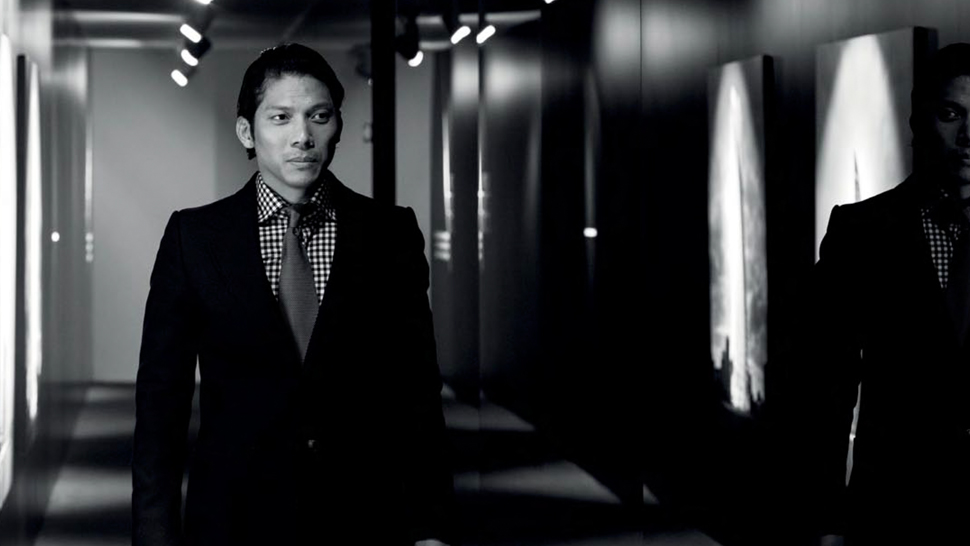
Robbie antonio introduced the concept of branding to prefabricated homes, an industry not normally associated with aspirational living
IMAGE Edric Chen
Robbie has been the managing director of Century Properties, the real estate development rm established in 1986 by his father Jose E.B. Antonio, and is responsible for the company’s direction toward branded collaborations like the Milano Residences by Versace, Acqua Livingstone by Missoni Home, Azure by Paris Hilton, Forbes Media Tower, Armani for Century Spire, and their newest luxury residences, the Trump Tower.
At the Design Miami fair last December 2015, Robbie launched his own company, Revolution Precrafted, showing a dining pavilion designed by Zaha Hadid and Patrick Schumaker, and a mobile gallery by Gluckman Tang (Hadid passed away in 2016, making the “Volu” pavilion one of her last projects; Robbie donated it to the Cannes amfAR auction, where it was sold for €1.3 million). He introduced the concept of branding to prefabricated homes, an industry not normally associated with aspirational living, and created something that has been done in retail—think Rodarte for Target, Balmain for H&M—but never before in homes and architecture.
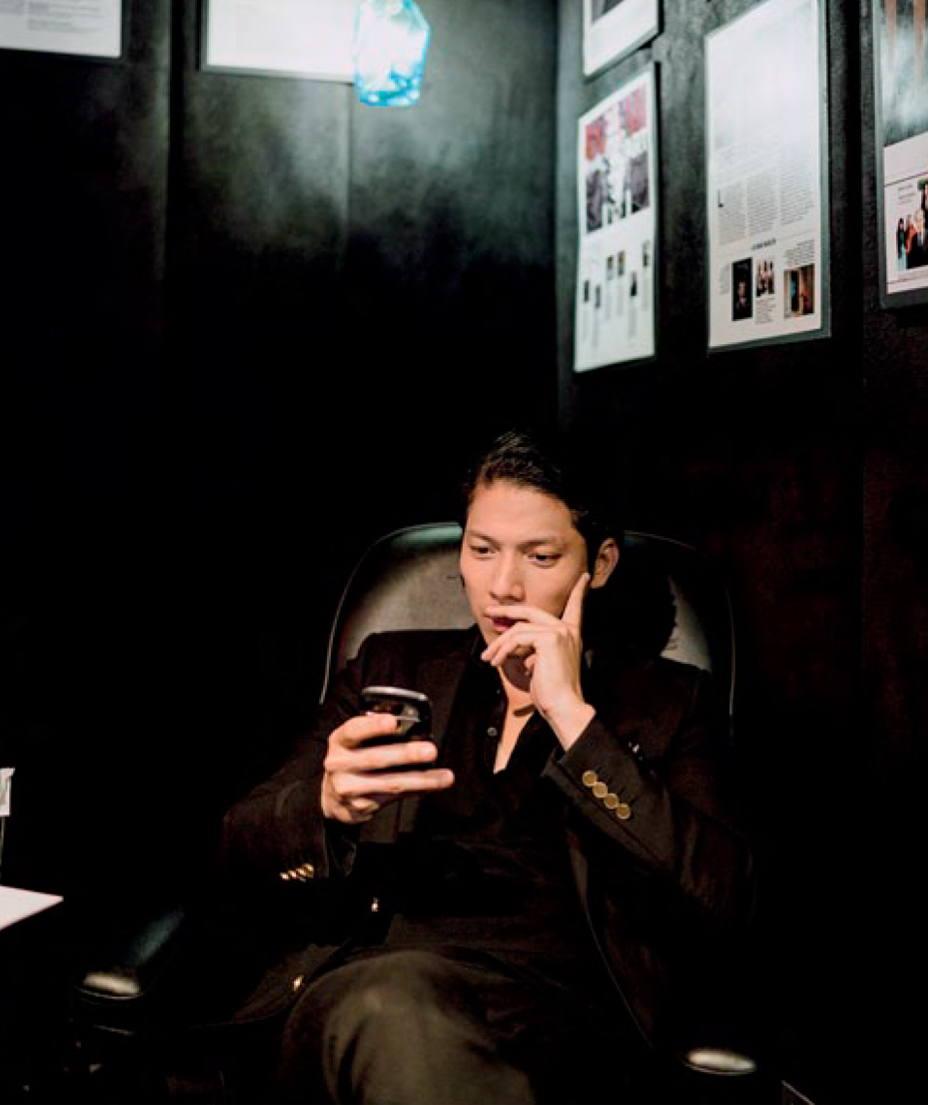
Prefab homes have been around since the automotive boom, borrowing the idea of assembly-line production where housing parts were mass-produced in a factory. Starting in 1908, the earliest kit homes were sold by mail on the Sears catalog, and throughout the decades, manufactured homes became popular low-cost housing options. In postwar France, pioneering French architect Jean Prouve designed “demountable houses” to address the housing shortage. Though now hailed as innovative modernist masterpieces, they failed to achieve commercial viability during his time. In the 2000s, architects started taking interest in modern prefab structures that tapped into a higher-end market, and the “great 21st-century prefab revival” was arguably kickstarted when Dwell magazine issued a challenge to create stylish yet affordable prefabs that can be mass-produced. On the market today are architect-designed prefabs, slick little Muji Huts, and a $1,100 Ikea flatpack shelter, as well as container vans, modular units, and artisan mobile homes that you can unmount and relocate, and the prevalence of these compact habitats has also fueled the tiny home movement.
IMAGE Edric Chen
So what do you get when you marry the convenience of prefab with the design power of Pritzker Prize-winning architects? A concept quite confounding, yet brilliant in its audacity. Robbie, through years of fraternizing with Hollywood celebrities, star athletes, Forbes-listers, movers- and-shakers of the art and design world, and yes, world leaders and their kin, has developed a virtual Rolodex of potential partners for his business plans.
It’s not an overstatement to say that Robbie is one of the most connected young Filipinos in the country today. Franco Varona, Revolution’s chief operating officer, breaks down the founder’s strange attraction: “He has this magnetic personality—once you meet Robbie, you’re not likely to forget him, and combined with his endless desire to close a deal, makes it very hard for anyone to say no to him.” This I can attest to.
It’s not an overstatement to say that Robbie is one of the most connected young Filipinos in the country today.
How Revolution Precrafted works, in a nutshell: You go online to Revolution’s website, choose a designer house, then click buy. Somewhere in a factory in India, Korea, Italy, or the Philippines, the parts are fabricated, usually with robotics, then shipped to you and assembled onsite, wherever you are in the world. Your very own Marmol Radziner, or if you want to go Filipino, Ed Calma abode without the hassle of hiring a whole team of contractors, manufacturers, builders, etc., and of course the astronomical fees of commissioning a famous architect.
Though the individual market is catered to, Revolution is primarily geared toward developers who can deal with building codes and mount many structures at once, whether for hotel and resorts, condos and residential areas, or commercial and art centers. In a couple of years, a “Revolution community” will pop up in Batulao, Batangas, where you can enjoy the cool mountain air in your prefabricated weekend home, or see art in a Jean Nouvel museum without having to go to the Louvre Abu Dhabi.
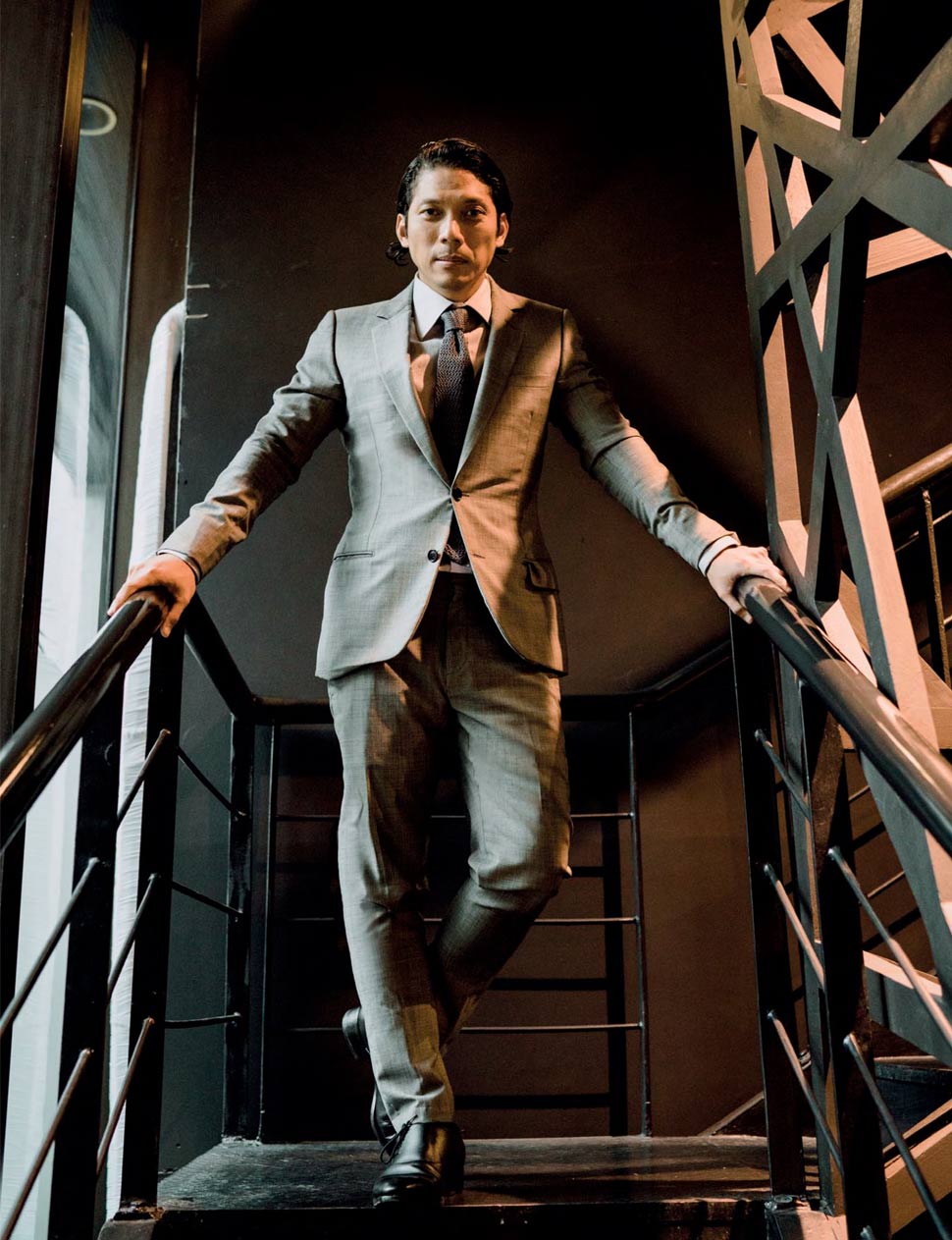
This democratization is at the core of Revolution’s “disruptive” philosophy. As a client who commissioned the legendary Dutch architect Rem Koolhaas to design his own house—a black concrete private museum/ residence in Forbes Park so stealth that only a select few have been inside—Robbie would know all about the tedious processes and prohibitive costs involved in building one’s dream house. In the infamous Vanity Fair article from 2013, Robbie had expressed that he wanted to work with ve Pritzker winners by the time he turns 45. Now only 40, he beat his own deadline in typical Robbie zealousness, and the new projects aren’t just for personal enjoyment, like those pavilions he started acquiring.
IMAGE Edric Chen
If it’s not obvious by now, Robbie is an obsessive collector of art, who has commissioned portraits from the likes of Julian Schnabel, Damian Hirst, and David LaChapelle. Artnet recognized him as one of the top 100 collectors in the world in 2016, putting him alongside Leonardo DiCaprio, Bernard Arnault, Paul Allen and other point one percenters. It was in thinking about these pavilions, collectible by only a tiny fraction of people who are art lovers, that led to Robbie’s eureka moment of developing branded homes for the middle market. “Honestly, in business, passion is not even enough. OBSESSION is key,” he says, and it’s this obsession—almost like a possession—that drives him to take his company to a whole different level.
“I’ve worked with 13 Pritzker Prize architects, possibly more than any human being in the world,” he says. “I love doing this! It’s not just about the valuation, it’s creating something so inherently different. We have intellectual property over all these names, you can get them at a ridiculously high price and wait a number of years, or get it from us in three months at a much cheaper price.”
How much cheaper? A few of the homes Revolution recently released are priced for the local market, starting at P3.5 million. Robbie has been working with, or shall we say convincing, a renowned Filipino architect and getting him to do one for P1.5 million. It’s a challenge on both their parts, creating something couture at Zara prices, while still keeping to the DNA of the architects and designers, who are used to blowing through sky-high budgets.
The first time I interviewed Robbie, the company hadn’t announced the news about its latest valuation yet, but his unicorn mission was already well known. According to Varona, unlocking unicorn level is Robbie’s singular focus, and all roads lead to that end goal. You can imagine what it must be like to work with him. In the office, there is an internal rule requiring people to answer emails and texts within 10 minutes of receipt, and accomplish tasks within 24 hours, regardless of how complex the task may be. The work culture in the Philippines usually allows for a little to a lot of leeway when it comes to responsiveness, but because Revolution’s employees push themselves, the result is that everyone, internally and externally, gets pushed to complete tasks much faster than a typical Filipino company. “Everyone working with Robbie must have an incredible resistance to stress, and used to not having sleep,” Varona says, adding, “He has given us all three years to make it a US$ 2 billion company.”
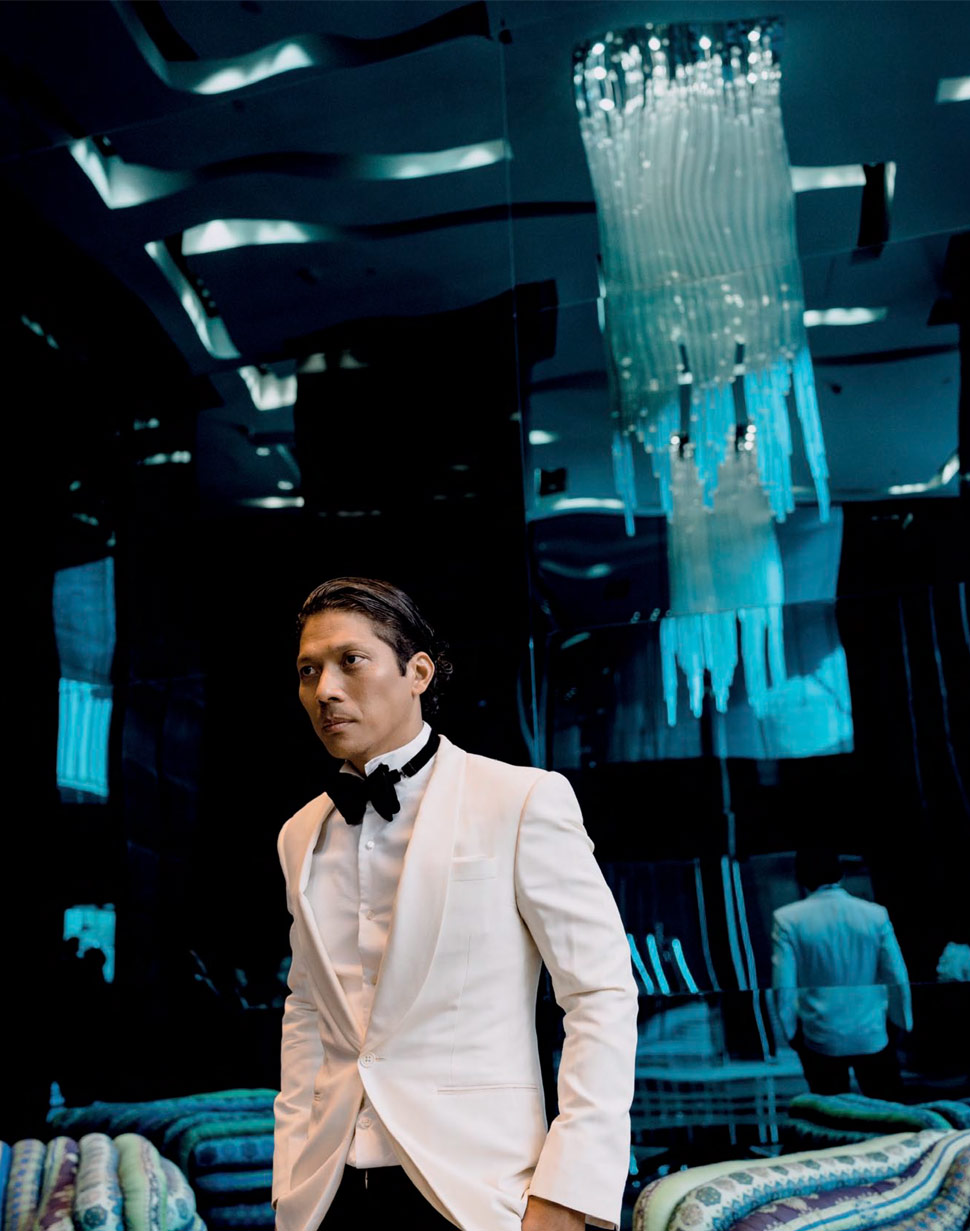
“I’ve worked with 13 Pritzker Prize architects, possibly more than any human being in the world,” he says.
IMAGE Edric Chen
When I meet with Robbie again, they had moved to a much larger, still all black, office at the top floor of the Pacific Star Building, and with it, more wall space to display their ever increasing portfolio of branded homes, as well as the press coverage that he embraces. Two bottles of Trump-branded sparkling wine adorn an otherwise empty black side table, and a quick Google search tells me that they’re produced in the state of Virginia, on the same valley where American president Thomas Jefferson tended his own vineyard. Robbie had just come back from New York, where he signed up a Victoria’s Secret supermodel to be part of the roster. She’s not an interior designer, but she partnered up with someone who is, and Robbie took a look at their portfolio and says he was convinced. If we’re talking about the democratization of design, surely that’s when a model can be given the same billing as Marcel Wanders, Philip Johnson, and the de Portzamparcs, who all have designed structures for Revolution. One of Revolution’s more interesting collaborations is with style icon plus Daphne Guinness, an heiress who works in fashion, music, lm and philanthropy—the ultimate intersection of celebrity and art that, to Robbie, makes for one hell of a sexy branded home.
Revolution’s goal for swift global domination is made possible by taking the business model of a real estate company and turning it on its head: “We’re the complete antithesis of the traditional real estate company. We cater to the world. We don’t have to be site-specific, we don’t have to buy land, take out construction loans, or have inventory.” Certainly, no one is handing out flyers on the street. Being asset-light has enabled the company’s rapid growth, and rapid growth attracts VCs like flies to honey. “I’ve been through at least three cycles in my life. Boom and bust. It’s so easy to have an economy taken from you, and I learned from that. If an economy doesn’t do well, I can go to one that is doing better. I can maneuver.”
Aside from offering homes via an e-commerce platform, Revolution is on the same league as other tech startups because of what the company will eventually will be—a platform for a smart home. Robbie often says they are the “Ikea of homes,” for its plug-’n-play simplicity, or the “Tesla of homes,” because Tesla is a technology platform on wheels more than it is a car. “Revolution will be a technology platform on foundations,” says Varona. More than just providing four walls and a roof over your head, the precrafted home can be as intelligent as you choose it to be. A house that behaves like Siri or appears sentient certainly gives new meaning to the phrase, “if these walls could talk.”
The next day, we go see one of the model homes in person, the “Simple” by Jean Nouvel, which was on display at the Tuileries Garden in Paris before it was transported to a construction site in Taguig. As the name implies, it’s a pretty straightforward structure, almost shed-like with a corrugated roof, aluminum exteriors, and Japanese-inspired mobile wooden partitions that allow the user to de ne the spaces inside. At 40 sq. meters, it’s a cozy one-bedroom, but modular and expandable to up to four bedrooms. Nouvel has said of the house: “What we propose here is the most immediate way to inhabit a space, within a short timeframe, in places that are not designed for residential use today and that become so, spontaneously.” Simple is a high- end, thoughtfully planned emergency shelter that Ja Rule would have been wise to consider for the Fyre Festival.
Speaking of disasters, Robbie is in the perfect position to roll out relief shelters should catastrophes strike, and this is something he pledges to do as part of the company’s CSR, having already supported Shigeru Ban with his “Paper Log” homes in Cebu. With temporary housing being subject to intense politicking and controversy—the FEMA trailers for Hurricane Katrina and the still-un nished housing projects for Typhoon Haiyan come to mind—Revolution could very well provide sustainable housing solutions that need not be merely temporary; structures that can be erected in a few days, con gured to suit different needs and unforeseen situations, and that also—why the hell not— look good. Shelters of all kinds have been imagined in response to the displacement of humans, but Revolution is perhaps the only Filipino company with the capabilities for mass-producing them, and more importantly, delivering them within a critical time frame.
“I’m known to be very impatient. I’m using my weakness as a skill set here, hopefully as an advantage, or an integral part of the business plan.” Basically, the need for instant grati cation drives everything he does. “Big time, all the time,” Robbie grins. “Is that bad?”
This article originally appeared under the title “The Obsession of Robbie Antonio” in the July 2017 issue of Esquire Philippines.
We’ve narrowed down the city’s most respected names and selected the very best.
ABOITIZ The family currently engaged in banking, power, and real estate among many other ventures traces its history in the Philippines to a Spaniard of Basque origin, Paulino Aboitiz, who arrived in the 1870s. He married the daughter of a well-to-do merchant a few years later, and started the rise of the Aboitiz clan in the southern Philippines, first in Leyte and later in Cebu. Starting with abaca trade, the family diversified following the claim of Paulino’s son Ramon (1887-1974) that “Any business where we can make money, we will go into.” Today, the family conglomerate Aboitiz Equity Ventures is chaired by Jon Ramon Aboitiz while his second cousin Erramon is the president and CEO.
IMAGE Courtesy of Aboitiz Family Ramon Aboitiz
ANTONIO The son of a banker, Jose Antonio founded his Century Properties real estate firm in 1986, just six days before the EDSA revolution. “Perhaps nine out of 10 of the most successful and wealthiest families derived and continue to derive incomes from real estate,” he reasoned in one interview. Today Antonio and his family are among the richest in the country, worth an estimated $260 million according to Forbes magazine. With all of his sons—Jigger, Marco, Robbie, and Carlo—involved in the business, the empire of the Antonios is ever expanding. The group’s exclusive developments include the Trump Tower, Knightsbridge and Gramercy Residences, Century City Mall, as well as collaborations with Philippe Starck, Missoni Home, and Versace Home.
IMAGE Dix Perez for Town and Country Marco, Carlo, Jigger, and Robbie Antonio
ARANETA The Aranetas of the LBC group have an interesting ancestor in the form of Don Gregorio Soriano Araneta, the secretary general of Emilio Aguinaldo’s Malolos Republic who also became the first Filipino solicitor general and secretary of justice and finance. Don Antonio Araneta, one of Gregorio’s 14 children, bought LBC Aircargo from its American owners in 1950, but it was his son Carlos “Linggoy” Araneta who made the firm a household name with his idea for 24-hour delivery service (Renamed LBC Express in 1988). Today Linggoy’s children Juan Carlos, Santi, Dino, and Monica hold the reins in the family company.
IMAGE courtesy of the Araneta family Don Antonio Araneta with son Linggoy in Germany, 1958
ARANETA In 1975, Muhammad Ali and Joe Frazier’s “Thrilla in Manila” put the country on the world’s sporting map. One of the stars of the show is still in place today, the majestic Araneta Coliseum, the crown jewel in industrialist J. Amado Araneta’s self-named Araneta Center in Cubao. This branch of Aranetas owes the start of its fortune to Juan Araneta, who founded the Ma-ao sugar refinery in Bago, City, Negros, over a century ago. The family patriarch today is Jorge Araneta, who keeps a tight watch over the Araneta Group with the help of his siblings Judy Araneta Roxas (mother of Mar Roxas) and Maria Lourdes “Baby” Araneta-Fores (mom to Chef Gaita Fores).
IMAGE Dix Perez Jorge Araneta
CAMPOS What began with a small corner store owned by Jose Yao Campos in 1945 is now the country’s largest drug-manufacturing company. And though the founder died in 2006, Unilab is still a family run business, now helmed by his daughter Joy Campos Hess and her son, Clinton Hess. Jose’s eldest son, Butch, runs another family founded company, Nutri-Asia, and serves as vice chairman of Del Monte Philippines, while also serving as chairman of Fort Bonifacio Development Corporation. Jeffrey D.Y. Campos oversees the family’s vast real estate holdings through Greenfields Development, whose projects include a multi-hectare property in Mandaluyong and the joint venture with another prominent family in Santa Rosa, Ayala Greenfield Estates.
CHAN After emigrating from Fujian Province, China, in the 1940s, Chan Lib and See Ying established the trading company Liwayway Marketing in post-war Manila. Who knew that it would lay the foundation for a multitude of successful business ventures including snack items (Oishi), lighting and bathroom fixtures (Chan C Bros), as well as a best-selling apparel brand (Bench)? The most prominent of the couple’s children are the media-shy Carlos Chan, and Nenita Chan Lim and Ben Chan, both of Suyen Corporation, the parent company of Bench and Dimensione, among other lifestyle brands. The third generation of Chans—including Carlos’s six children and Nenita’s two—are slowly filling in the big footsteps of their parents in their respective companies.
IMAGE Magic Liwanag
COJUANGCO No list about Philippine families is complete without mentioning the Cojuangcos. The descendants of a Chinese immigrant, Co Yu Hwan, members of this extended family have become influential in business, politics, and society, settling first in Bulacan and then Tarlac. From the second generation, Melecio Cojuangco’s children were Jose Cojuangco Sr. (the father of Corazon Aquino and Peping Cojuangco), Antonio (the father of PLDT’s Ramon), and Eduardo Cojuangco Sr. (Danding’s father). The fifth generation Cojuangcos include President Noynoy Aquino, Tonyboy Cojuangco, Mikee Cojuangco-Jaworski, Congressman Mark Cojuangco, and Charlie Cojuangco.
CONCEPCION Behind the continuing success of this multi-generational business family are perhaps the most prominent set of twins in Philippine society, Ronnie and Joecon Concepcion. The 84-year-old brothers born just 10 minutes apart are the sons of industrialist Jose Concepcion Sr., the founder of Concepcion Industries and co-founder of RFM Flour Mills along with Salvador and Victoria Araneta, the inlaws of Joecon. Ronnie’s side of the family includes former &C cover subject Ton Concepcion as well as current Concepcion Industries president, Jojo Concepcion. John of Selecta and Joey of Go Negosyo fame are the sons of Joecon. The twins’ sister is Mely Concepcion Hechanova, whose daughter, Renna, is vice chair of Condura.
IMAGE courtesy of the Concepcion family The Concepcion couples, from left: Joe and Marivic Concepcion, Paeng and Mely Hechanova, Jose and Hermina Concepcion, Ronnie and Menchu Concepcion, Rene and Susan Concepcion
CONSUNJI Cornflakes in the morning, then paksiw na bangus or torta for lunch—simple fare for a not-so-simple man, David Consunji of DMCI. The construction titan is the ninth richest Filipino according to Forbes magazine, but his old habits and virtues—honesty and living simply among them—die hard. While the architects behind famous buildings are better known, it was Consunji’s company that erected them: the Cultural Center of the Philippines, Philippine International Convention Center, Westin Philippine Plaza, and the Ayala Triangle, just to name a few. Sid, the eldest son, handles the construction firm now, with siblings Jing, Victor, Jorge, Lucy, Cristina, and Dinky also involved.
DELGADO Three prominent branches of the Delgado family were at one time all part of, appropriately enough, the Delgado Brothers company. Founded by Antonio Delgado in 1946 with his brother Francisco (Don Paco) and Jose, Delbros was a pioneer in logistics, later on expanding into trading, investments, and port operations. After leaving the company, Don Paco further increased his wealth by going into shipping and real estate. Today Delbros is run by Antonio’s son Eduardo (married to Margarita Delgado of Teach for Philippines) and grandson Jose Paolo Delgado.
ELIZALDE Another family with Basque origins, the Elizalde name has been prominent for more than 150 years, first gaining notice through Don Joaquin Elizalde, a sugar baron in Panay and Negros, whose descendants would acquire Tanduay Rhum from the Ynchausti family in the 1920s. Though the Elizalde clan sold the liquor company to Lucio Tan in the 1980s, it still has significant land holdings and one descendant, Don Joaquin’s grandson Fred Elizalde Jr., still owns majority of Manila Broadcasting Company running it with his son, Juan. Fred’s wife, Lisa Macuja, heads the prestigious ballet company Ballet Manila. Other well-known Elizaldes include Francisco Elizalde (married to Pamen Roxas) father to Patxi, Santi, and Carlos.
GOKONGWEI The story of this family’s patriarch doesn’t quite follow the typical rags to riches arc. Riches to rags to riches would be more apt. Born to a well off Chinese family in Cebu, the family fortune was lost when John’s father died suddenly. He revealed how he got back on his feet with a speech at the 20th Ad Congress: “So, what can I do? I worked.” Now 90, Gokongwei has surrendered duties in his companies to his children. Only son Lance picks up most of the slack at Cebu Pacific and JG Summit, while eldest child Robina is the president of Robinsons Retail Holdings, which has Robinsons Department Store, Robinsons Supermarket, Handyman, and Toys R’ Us under its wing.
GOTIANUN Andrew Gotianun called it a day back in the 1980s, hoping to spend a life in easy retirement with his wife Mercedes. But not much later he was back in business, taking charge again of Filinvest Development Corporation, the company he founded in 1955, armed with new ideas on how to take it further. His second wind gave Filinvest enough momentum to push the Gotianuns up to 18th on the richest Filipinos list of Forbes magazine in 2015. He passed away in March 2016, with four of his children carrying the load in the company, Josephine (president and CEO), Jonathan (chairman), Andrew Jr. (director), and Michael (vice president). His wife Mercedes is chairman emeritus.
LAUREL The family used to be a fixture in politics, but as the clan expanded, so has its realm of influence in society. Today’s generation of prominent Laurels are descendants of the nine children of José P. Laurel (1891-1959), the third President of the Philippines. Among the notables in the brood were former Vice President Salvador “Doy” Laurel, former Senate President Pro Tempore Sotero Laurel II, former House Speaker José Laurel Jr., and Arsenio Laurel, whom sports buffs will remember for winning the Macau Grand Prix twice. In this generation, we have the educators Bobby and Peter Laurel of Lyceum University (Manila, Laguna, and Batangas), fashion designer Rajo Laurel, stage actors Cocoy and Franco Laurel, and television personalities Patty and Denise Laurel.
IMAGE courtesy of the Laurel family Jose P. Laurel with Rose Laurel-Avencena, Francis Cardinal Spellman, Pacencia Laurel, Nene Laurel, and Alice Yulo Laurel
LOPEZ Few families have gone through the ebbs and flows of fortune like the Lopezes of Iloilo. Guiding the family through its most difficult times was Don Eugenio Lopez (1901-1975), who resurrected the family fortunes (drawn mostly from sugar) after World War II, only to lose almost everything in the dark days of martial law. Though he didn’t live to see his companies (Meralco, ABS-CBN, Manila Chronicle) returned to the family, his sons Geny (“El Capitan”), Oscar, and Manolo ushered in a new era of prosperity after the 1986 EDSA revolution. The next generation is led by Piki Lopez (First Philippine Holdings) and Gaby Lopez (ABS-CBN).
IMAGE courtesy of the Lopez family
LORENZO You don’t get to have a university sports facility named after you for no reason. Luis “Moro” Lorenzo certainly earned that right, after being a hoops star for Ateneo in the late 1940s and later as a visionary businessman. In the early 1980s he purchased and turned around a failing banana exporting company; now Lapanday Holdings is one of the largest independent producers and exporters of pineapples and bananas in the country. He passed away in 1997. From his eight children, eldest daughter Rica L. Davila is now the firm’s CEO and chair, while her younger brother Tomas is the vice chair. Outside the company, Martin found success operating numerous restaurant chains, while youngest Isa is an esteemed gallerist and artist.
IMAGE courtesy of the Lorenzo family Luis Lorenzo
MADRIGAL From humble beginnings in Albay, Don Vicente Madrigal amassed an empire built on shipping, coal, cement, and real estate to become one of the country’s wealthiest men as well as a senator in the mid 20th-century. His wife Susana was his lucky charm, as it was she who had the foresight to buy large tracts of land in Mandaluyong, Muntinlupa, Canlubang, and Laguna. Upon his death, Don Vicente’s wealth was equally divided among his seven children, but it was Consuelo Madrigal (1921-2008) who achieved the greatest prominence in business and social circles, especially known for her philanthropy. Paz, another daughter, also became a Philippine senator in the 1960s. The Madrigal legacy lives on through the grandchildren of Don Vicente and Susana, which include brothers Vicente II and Gerardo Madrigal, Chu-Chu Madrigal, former senator Jamby Madrigal, and Ging Gonzales-Montinola.
MONTINOLA According to family lore, the first Montinola to reach Philippine shores was Juan Montinola, who arrived in 1781 from Malaga, Spain. By the mid-1800s, the family had already risen to prominence in Iloilo. Ruperto Montinola, the great-grandfather of former Bank of the Philippine Islands president Aurelio “Gigi” Montinola III, was even elected the province’s governor. It was Aurelio Sr., a lawyer, who established the family in Manila shortly after World War II. One of his sons, Aurelio Jr., married Lourdes Reyes, the only daughter of Nicanor Reyes, the founder of Far Eastern University. Since Gigi stepped down from BPI, he’s busied himself with being the FEU’s vice chair, sitting on the board alongside his mother, sister Gianna, and brothers Juan Miguel and Anton.
ONGPIN The family name is virtually synonymous with Binondo, Manila’s Chinatown. On its most important avenue stands a statue of the clan’s founding patriarch, Don Roman Ongpin. A dealer in art supplies, his store El 82 was patronized by the likes of Juan Luna and Felix Resurrecion Hidalgo—but his most important contribution to society was being a supporter of the Philippine revolution. Today, his descendants still make the headlines and society news—including former Town&Country cover subjects Lisa Ongpin Periquet and Michelle Ongpin. The two are the offspring of the brothers Jaime (Jimmy), the former finance minister under Cory Aquino, and Alphaland chairman Roberto (Bobby), respectively. Another scion of the clan, Deanna Ongpin-Recto is a champion of the arts as is Jaime’s widow, Maribel.
IMAGE courtesy of the Ongpin family
ORTIGAS The Ortigas clan’s vast landholdings comes from Francisco “Don Paco” Ortigas (1875-1935), a successful lawyer who in 1931 purchased the Hacienda de Mandaloyon from the Augustinians, in partnership with Vicente Madrigal and a few others. The 4,033-hectare property spans the cities of San Juan, Pasig, and Quezon City. If you’ve ever wondered who Julia Vargas is while driving in Ortigas Center, it is none other than Don Paco’s wife. The properties are managed today by the family’s holding firm Ortigas & Co. Limited Partnership Holdings. Among the key people in the clan are Rafael Ortigas Jr., Fernando Ortigas, Ignacio Ortigas, Francisco “Pacqui” Ortigas III, and “Ish” O. Montilla, the son of Chari Ortigas.
IMAGE courtesy of the Ortigas family Amalia, Julia, Carmen, Maria Asuncion, Rosario, Francisco and Eduardo Ortigas
PADILLA Nicanor Escobar Padilla (1851-1936) from Pangasinan started a clan noted for producing prominent doctors, lawyers, and legislators. His brood of 11 (nine from his second wife, Ysabel Bibby) included Justice Sabino Padilla, Senator Ambrosio Padilla, Congressman Benedicto Padilla, Dr. Nicanor Padilla, and Dr. Florencia P. Dualan. From the succeeding generations, we have Justice Teodoro Padilla (the father of renowned eye doctor Minguita Padilla Lopez and lawyer Sabino “Binoy” Padilla), PhilHealth President Alexander Padilla, Couples for Christ’s Francisco Padilla, NYC-based lawyer Monique Padilla Gallego, and international banker Maite Padilla Gallego.
RUFINO A big family of real estate moguls, bankers, philanthropists, and artists, the different branches can trace their roots from the children of Macario Rufino: Ernesto, Vicente, Ester, and Rafael (their initials are where the old EVER Theater in downtown Manila got its name). The siblings developed a chain of cinemas, including the legendary Rizal theater and QUAD in partnership with the Ayalas. They also co-founded two banks. Charlie, the son of Vicente Rufino (yes, the street in Makati is named after him) and brother of Marixi Prieto, is among the most visible of the current generation, being one of the top developers in Taguig and Makati. The artist Marivic, the daughter of Rafael, is also a regular on the social circuit.
IMAGE courtesy of the Rufino family Ditas, Charlie, Cory, Marixi, mom Meding, Pixie, and Ma. Paz Rufino
SY For the eighth year running, Henry Sy is the country’s richest man, estimated to be worth $12.6 billion by Forbes Magazine. Now 92, Sy has long since transferred power in his various companies to his six children. Tessie Coson is in charge of the family’s banking interests in BDO Unibank; Elizabeth takes care of SM Hotels & Conventions Corporation. The eldest son, Henry Jr., chairs SM Prime, while Hans moved to a director role recently. Harley is in charge of the retail units Supervalue and Super Shopping Market (SM Hypermart), while Harley, the youngest, oversees the department stores division and SM Investments.
IMAGE courtesy of the Sy family Henry Sy
TAN From living in a small one-room apartment to owning vast tracts of land here and in Spain (with more than 1,500 hectares of vineyards for his brandy business alone), Andrew Tan has come a long way in a relatively short time. He became a millionaire at 27 through his appliance business, but it was his distillery (makers of Emperador Brandy) and real estate firm (Megaworld) that elevated him to megarich status. His wife Katherine is also involved in the family businesses. The couple has four children: Kevin, Kendrick, Kester, and Kara.
TAN Over the past two years, the consolidation of El Capitan’s companies has paid off—to the tune of $4 billion. Share prices of Lucio Tan’s companies got a boost thanks to the prospect of more efficient management (eldest son Michael is in charge), making him the fourth richest in the land. At 82, Tan is still very much hands-on, known for calling business meetings with his top brass that last deep into the night. Daughter Cherry is married to Alfred Ty, son of Metrobank’s George Ty.
Lucio Tan
TANCAKTIONG Tony Tan Caktiong’s family run company is truly bigger than ever with more Jollibee branches across the globe opening regularly. According to Forbes, it is the “fastest-growing Asian restaurant chain in the world” to date. Hey, even Anthony Bourdain gave the Aloha burger a thumbs up. Over the years, the family snapped up other fast-food restaurants including Chowking, Greenwich Pizza, and Red Ribbon, among others, all leading to a rise in Jollibee’s listed share price (and Tan’s net worth, now $3.8 billion). Part of the company since the beginning, Tan’s wife Grace leads the Jollibee Foundation, while eldest child and only son Carl Brian is the company’s business development director. His two daughters live in California.
TANTOCO If there’s a family who knows about luxury, it’s the Tantocos. Since 1951, when Bienvenido Tantoco and his wife Gliceria Rustia opened Rustan’s (a clever portmanteau of their names) the family has provided only the best in retail shopping for discerning Filipino consumers. Even their supermarkets have a luxury touch, often having gourmet items not found in other places. With the third generation of Tantocos there has been a growing expansion, not just in the acquisition of foreign luxury brands, but notably in restaurant and retail franchising, such as with Starbucks, Golden Spoon, and Family Mart.
IMAGE courtesy of the Tantoco family Menchu T. Lopez, Nedy Tantoco, Gliceria Tantoco, Merl Tantoco-Pineda, and Bienvenido Tantoco
TY When a young George S.K. Ty ran out of money in his early 20s (he was setting up a flourmill at the time), he asked for a loan from a bank. Furious about getting denied, he vowed to put up a bank of his own. At 29 he did just that, opening Metrobank in 1962. It is still the greatest source of the Ty family’s wealth, but they have diversified by going into real estate, insurance, and power generation. Ty might be ranked higher on the list of richest Filipinos, if not for his philanthropic nature—he once donated $100 million to build a Catholic church in China and funded the building of a technical school in Laguna. Sons Arthur and Alfred now run the bulk of the family enterprises.
YAP Known to be one of the more flamboyant of the Filipino-Chinese tycoons, Emilio Yap’s crown jewel is the Manila Hotel, which is over a century old. He passed away in 2014, but the family’s influence and power carry on, much of which still comes from the Manila Bulletin, the daily paper his family has been involved in since the 1960s. The family is also into banking (Philtrust Bank), pharmaceuticals (Euro Med Laboratories), shipping (President Lines) and education (Centro Escolar University). Emilio’s son Basilio Yap took over as chairman of both Manila Hotel and Manila Bulletin, while his grandson Emil Yap III continued to serve as vice chairman of the hotel and executive vice president of the newspaper and Enrique Yap Jr. takes the reins as the hotel’s executive vice president.
IMAGE Medal Elepaño
YUCHENGCO After inheriting his father’s insurance business, Alfonso Yuchengco steadily built an empire of his own, getting involved in everything from banking and education (RCBC, Mapua Institute of Technology) to car dealerships and construction (Honda, EEI Corporation). Among his children, daughter Helen Y. Dee is most likely to assume the mantle of leadership in the Yuchengco businesses. “A.Y.”—as the ambassador is known in business circles—is a food and wine aficionado, and a member of the exclusive Chaine des Rotisseurs. Pastry chef Sunshine Pengson (daughter of Bella Yuchengco), is A.Y.’s granddaughter.
IMAGE courtesy of the Yuchengco family Alfonso Yuchengco
ZOBEL Enrique Zobel attained success in real estate, construction, insurance, and agriculture. Of his two surviving children, Inigo is the more visible—an astute businessman, he’s also a fixture on the polo circuit. Enzo’s daughter Mercedes (Dedes) and second wife Dee prefer to keep a low profile, and both are engaged in philanthropy. Young Zobels coming into prominence include Inigo and Maricris’s son Jake and daughters Bianca and Natalia who recently opened lifestyle special store LANAI.
ZOBEL DE AYALA The family behind the Ayala Group of Companies (Ayala Land, BPI, Globe Telecom, Manila Water) traces its roots in the Philippines to Antonio de Ayala, who arrived in the early 1800s. The Zobel part of the name comes courtesy of Jacobo Zobel, who married Trinidad, Antonio’s daughter. The current patriarch, Jaime Zobel de Ayala, is happily retired, stepping down to devote more time to his photography hobby, most likely. His two sons, Jaime Augusto (“JAZA”) and Fernando, out of the seven children, work for the Ayala group. JAZA’s daughter Mariana, a Harvard graduate, works with Ayala Malls. His son Jaime Alfonso, also a Harvard grad, works at Globe.
IMAGE courtesy of the Zobel de Ayala family
This story originally appeared on Townandcountry.ph.
How, where, and even why you went to college probably won’t be an indication on how your life (and bank account) will turn out, but the answers might carry some privileges. Bill Gates himself—the world’s riches man and a college dropout—regularly stresses the value of education:
“I think the value of getting a great education—that is going to college—is easy to underestimate. The most interesting jobs require a college education. The STEM related jobs are probably the most interesting although they are not for everyone. The value of staying curious—reading a lot and learning new things even after college is also underestimated.” (March 2016, Reddit AMA)
Gates constantly advocates for college education on his blog, once writing, “Although I dropped out of college and got lucky pursuing a career in software, getting a degree is a much surer path to success”; he’s also called the college dropout rate in the United States “tragic.”
It’s the same here. Though some of the Philippines’ richest individuals may not have completed their degrees, they still emphasize the value of education—if not in words, then through their actions: sending their children to topnotch institutions, providing scholarships, and donating academic facilities. Here we look at the academic histories of some of the country’s richest for inspiration:
Henry Sy Sr. ($18 billion) Chiang Kai Shek College (high school) Associate Arts, Commercial Studies, Far Eastern Universtiy (1950)
John Gokongwei Jr. ($6 billion)* San Carlos University MBA, De La Salle University (1961) Harvard Management Program (1971)
Enrique Razon Jr. ($4.3 billion) BS Business Administration, De La Salle University (1980)
Lucio Tan ($4.2 billion) BS Chemical Engineering, Far Eastern University Received an honorary doctorate degree from the University of Santo Tomas under the Expanded Tertiary Education Equivalency and Accreditation Program (2003) Received a BS Chemical Engineering degree from the University of Santo Tomas under the Expanded Tertiary Education Equivalency and Accreditation Program (2006)
Jaime Zobel de Ayala ($3.7 billion) BA Architectural Science, Harvard University (1957) Took the Advanced Management Program by the Harvard Graduate School of Business Administration in Baguio (1963)
David Consunji ($3.6 billion) BS Civil Engineering, University of the Philippines (1947) Consunji passed away in September 2017
George Ty ($3.6 billion)* BS Commerce, University of Santo Tomas Enrolled in 1955 but dropped out to focus on business Received an honorary Humanities doctorate from the same university in 2014
Tony Tan Caktiong ($3.4 billion) BS Chemical Engineering, University of Santo Tomas (1975) Earned certificates from Harvard University, Asian Institute of Management, University of Michigan Business School, and Harvard Business School Received honorary doctorates from the Far Eastern University, St. Paul University, and Southwestern University
Andrew Tan ($2.5 billion) BS Accounting, University of the East (1974)
Ramon Ang BS Mechanical Engineering, Far Eastern University (1981)
Manuel Villar ($1.65 billion) BS Business Administration, University of the Philippines (1970) Masters in Business Administration, University of the Philippines (1973)
Robert Coyiuto Jr. ($1.5 billion) BSC, San Beda College
Mercedes Gotianun ($1.4 billion) BS, University of the Philippines (1950)
Roberto Ongpin ($1.15 billion) BS Business Administration, Ateneo de Manila University (1957) Masters in Business Administration, Harvard University
Eduardo Cojuangco ($1.1 billion)* Lafayette College
Dean Lao ($1 billion) BS Chemical Engineering, Polytechnic Colleges of the Philippines
Ricardo Po Sr. ($980 million)* BS Industrial Chemistry, University of Santo Tomas Masters in Business Administration, University of Santo Tomas (2005)
Edgar Sia ($820 million)* BS Architecture, University of San Agustin
Oscar M. Lopez ($760 million) BA Harvard University (1951) Masters in Public Administration, Littauer School of Public Administration, Harvard University (1955) Received an honrary doctorate from the De La Salle University (2010) Received an honorary doctorate from the Ateneo de Manila University (2010) Received a Doctor of Laws honoris causa from the Philippine Women’s University (2009) Received a Doctor of Laws honoris causa from the University of the Philippines (2012)
Carlos Chan ($620 million)* BS Architecture, Mapua Institute of Technology
Alfredo Yao ($600 million)* BS Chemical Engineering, Mapua Institute of Technology (1962) Received an honorary doctorate from the Polytechnic University of the Philippines
Frederick Dy ($520 million) BS Industrial Engineering, Cornell University
Jacinto Ng ($420 million) BS Chemical Engineering, Mapua Institute of Technology
Jose Antonio ($400 million, with his son, Robbie) BS Commercial Science, San Beda College (1966)
Robbie Antonio ($400 million, with his father Jose) BS Economics, Northwestern University Masters in Business Administration, Stanford University
Michael Cosiquien ($385 million) BS Civil Engineering, De La Salle University (1995)
Jorge Araneta ($380 million) BS Business Administration, University of the Philippines
Edgar Saavedra ($375 million) BS Civil Engineering, De La Salle University (1996)
Mariano Tan Jr. ($370 million) BA Economics and Business, Lafayette College (1983) Master of Science in Management, Hult International Business School Massachusetts (1986)
Jon Aboitiz ($350 million, with his brother Mikel) BS Management, Santa Clara University
Mikel Aboitiz ($350 million, with his brother Jon) BS Business Administration, Gonzaga University
Manuel Zamora ($280 million) BS University of the Philippines University of the Philippines Law School Ranked 3rd on the Bar in 1961
Wilfred Steven Uytengsu Jr. ($240 million) BS Business Administration, University of Southern California
Vivian Que Azcona ($230 million) BS Pharmacy, University of Santo Tomas (1977) Management Program, Asian Institute of Management (1978)
Eric Recto ($225 million) BS Industrial Engineering, University of the Philippines Masters in Business Administration, Johnson Graduate School of Management, Cornell University
Jose Ma. Concepcion ($220 million) BS Business Management, De La Salle University
Bienvenido Tantoco Sr. ($190 million) BCS Jose Rizal College (1941)
Felipe Gozon ($170 million)
Bachelor of Laws, University of the Philippines Master of Law, Yale University Ranked 13th on the Bar in 1962
Menardo R. Jimenez ($165 million) BS Commerce, Far Eastern University BS Accounting, Far Eastern University
Walter William Brown ($160 million) BS Physical Science, University of the Philippines (1959) BS Geology, University of the Philippines (1960) Master of Science in Geology, Stanford University (1963) Doctorate in Geology, Major in Geo-Chemistry (1965)
Gilberto Duavit ($155 million) AB Philosophy, University of the Philippines
Eusebio Tanco ($150 million) AB Economics, Ateneo de Manila University Master of Science in Economics and Political Science, London School of Economics
Juliette Romualdez ($145 million) BS Education, Maryknoll College
Michael Romero ($135 million) BS Management, De La Salle University Masters in Business Management, Asian Institute of Management Doctorate in Business Administration, De La Salle University (2006) Doctorate in Political Economics (2008)
Erramon Aboitiz ($130 million) BS Business Administration Major in Accounting and Finance, Gonzaga University
Luis Virata ($125 million) AB Economics, Trinity College, Cambridge University Master of Arts in Economics, Trinity College, Cambridge University (1976) Masters in Business Administration, Wharton School, University of Pennsylvania (1979)
Philip Ang ($120 million) Business Administration, Oregon University Masters in Business Administration, University of Denver
The release of the Forbes Philippines’ 50 Richest list always makes the headlines, even if there are few surprises. This year, for example, SM mogul Henry Sy tops the list for the tenth time in a row, followed—again—by John Gokongwei and Enrique Razon.
It’s a different story when you look at the younger billionaires on the list. This is where you find new names and a few interesting stories. With more or less self-made fortunes, the under-45 tycoons here have earned their places on the list through lots of hard work, some smarts, luck—and sometimes a little bit of cunning.
IMAGE Rennell Salumbre
EDGAR SIA, 40 (Double Dragon Properties), ranked #21 with US$840M
At 40, Injap Sia is both the youngest on the Forbes list and also the highest-ranking among the under-45 set. More importantly, his fortune is entirely self-made: the young entrepreneur was only 26 when he opened the first Mang Inasal store, which he sold to Jollibee Foods Corp. for a total of Php5 Billion. Though he no longer qualifies as a dollar billionaire as of this year (he was listed at #17 with US$1.2B in 2016), it’s still a big improvement from the #34 spot he held in 2015. The surge was attributed to the rapid growth and expansion of Double Dragon Properties, a real estate development company that he owns alongside partners like Jollibee founder Tony Tan Caktiong.
IMAGE Edric Chen
ROBBIE ANTONIO, 40 (Century Properties), ranked #28 with US$400M (together with his father, Jose Antonio)
After landing on the cover of our July 2017 issue, Robbie Antonio joins his father, Jose Antonio, on the Forbes list, coming in at #28. It’s the family-owned Century Properties that earns them their position on the list, but Robbie’s own startup, Revolution Precrafted Ltd., gets special mention. The maker of prefabricated luxury homes is currently valued at US$256M, after launching in 2015.
IMAGE Forbes
MICHAEL COSIQUIEN, 43, and EDGAR SAAVEDRA, 42 (Megawide Construction), ranked #29 with US$385M and #31 with US$375M, respectively
Michael Cosiquien and Edgar Saavedra were only in their early 20s, just out of college, when the pair founded their own company in 1997. It was tantamount to “on-the-job training for us,” Cosiquien told Inside Business with Coco Alcuaz in 2014. Both civil engineers, it took courage to have put up Megawide Construction then, since the economy was in the depths of the Asian financial crisis. It wasn’t until around 2007 that the company began to really take off, after having bagged major projects from SMDC. Today, Megawide has expanded from their core business, and now has interests in the Mactan Cebu International Airport and even in power generation—the company owns three solar power projects that together supply about 100 megawatts to the national power grid.
IMAGE Congressman Mikee Romero Facebook
MICHAEL ROMERO, 44 (GlobalPort 900), ranked #47 with US$135M
One of the most colorful characters on the list, Michael Romero has certainly had his ups and downs over the past year. Romero was elected to Congress as the 1-Pacman Party List representative in May 2016; months later, a court ordered his arrest over charges of embezzlement from the family-owned company Harbour Centre Port Terminal, Inc. Even before that, Forbes reports that Romero’s holding company, GlobalPort 900, “was delisted from the Philippine Stock Exchange and trading suspended in May 2014 in what he described then as a temporary software mix-up.” Romero is currently in hiding, with his whereabouts unknown since the warrant for his arrest was issued in January 2017.
THE REVOLUTION WILL BE LIVE. Take a hard look at the influence, power, and obsessions of Robbie Antonio in our July 2017 issue, where the Century Properties scion talks to us about his startup, Revolution Precrafted, and his quest for its billion-dollar valuation.
IMAGE Edric Chen
Inside: Washington Sycip, pillar of Philippine finance, talks about the considerable lessons he has learned over his lifetime. Meet internationally acclaimed documentary photographer Xyza Cruz Bacani, who rose from obscurity and her job as a domestic worker to become a Magnum Foundation fellow and one of the most talked-about Filipino photographers today. Also, in this month’s Notes & Essays: Violence, according to Lakan Umali, G.M. Enriquez, and Miro Capili; with photos by Carlo Gabuco.
Plus: In time for Game of Thrones’ penultimate season, Kit Harington speaks to Esquire about transcending his role as the wonderboy of Westeros; Carlo Gabuco and Luis Liwanag show us the view from the ground in Marawi; we list down ten cool trinkets that you can get your hands on now in this month’s Esquire 10; and Mona Lisa Neuboeck is a Woman We Love.
Read all these and more in the July 2017 issue of ESQUIRE. A digital edition is available at bit.ly/esquireph.
On the cover: Robbie Antonio, founder and CEO of Revolution Precrafted, photographed exclusively for Esquire Philippines by Edric Chen; with grooming by Joan Teotico using NARS Cosmetics, and hairstyling by Jayjay Gallego for Creations by Lourd Ramos Salon and Brix Batalla. Shot on location at Milano Residences.