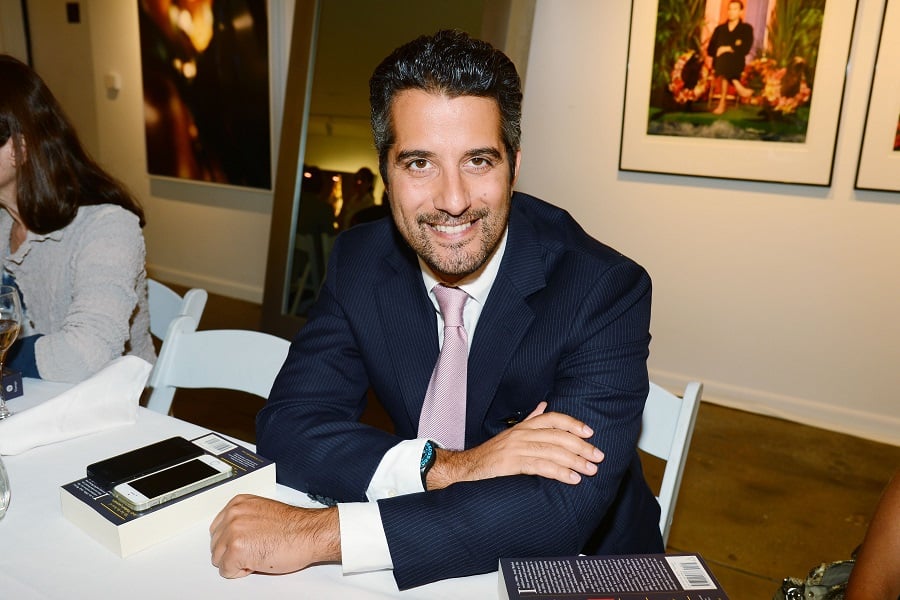
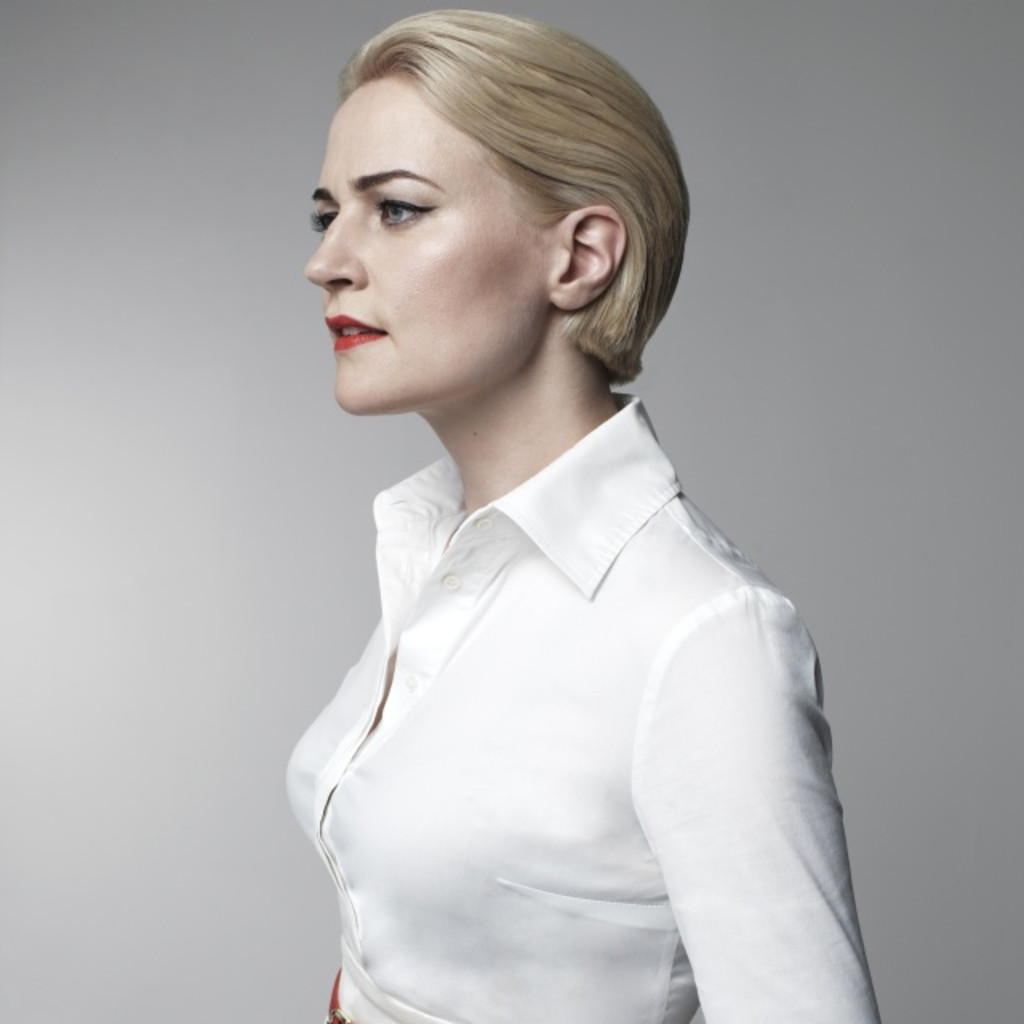
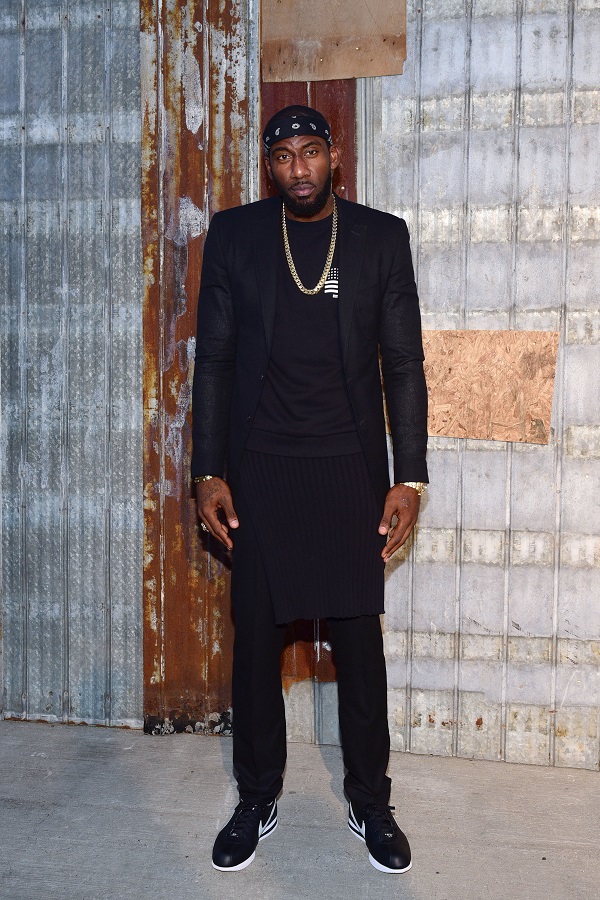
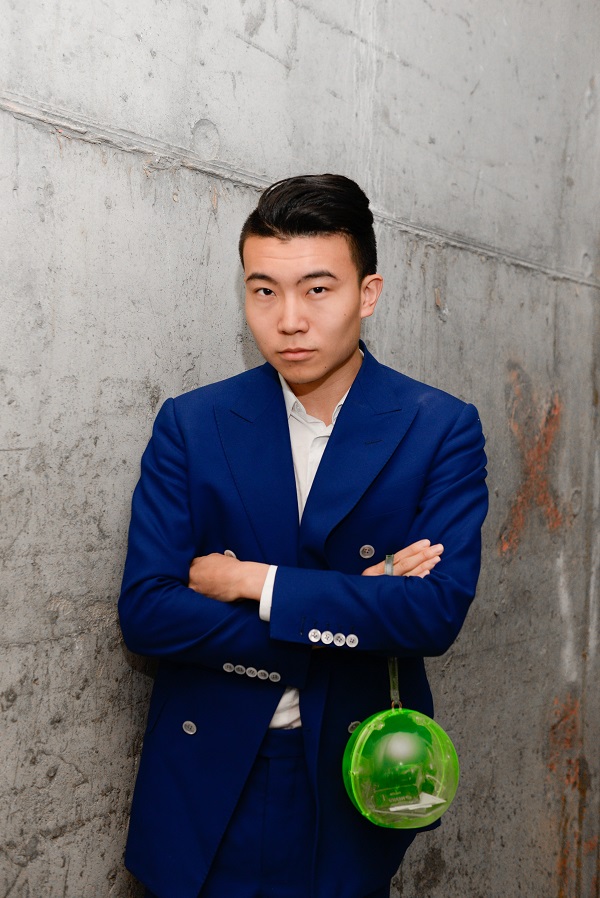
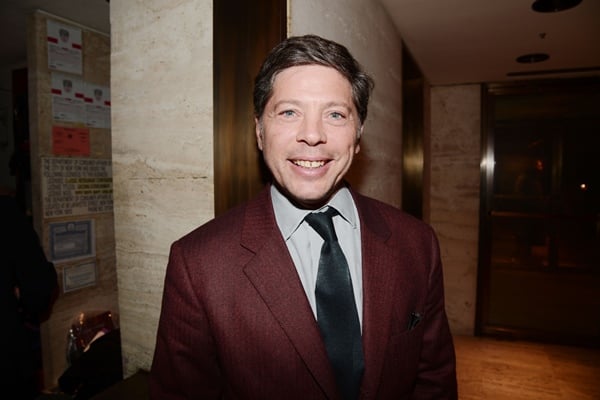
How does an art collection begin? We asked seven collectors to tell us the story of the work that started it all, and how their first acquisitions shaped their collecting habits for the future. Their influential early acquisitions range from an Aaron Young video to a lithograph purchased with winnings from dorm-room poker. Together, their stories reveal that art collecting is all about paying close attention—and being open to adventure.
Top Collector Robbie Antonio Family Has Substantial Business Ties to Donald Trump. As the businessman prepares to step into the role of president, a lengthy New York Times story on November 26 takes aim at US president-elect Donald Trump’s financial ties and potential conflicts worldwide.
The story opens with a discussion of Jose E.B. Antonio, a Philippine developer who is the father of Robbie Antonio, one of artnet New’s top collectors to watch and a fixture on the art circuit; Robbie is seen frequently at high-profile events including art fairs and major auctions, including Sotheby’s recent Impressionist and modern art evening sale earlier this month.
According to the Times report, E.B. Antonio, who was “quietly named a special envoy to the United States by the Philippine president Rodrigo Duterte,” is building a $150 million tower in Manila’s financial district. His business partner is none other than Trump.
Announcement of Trump Tower Manila. Courtesy of Flickr Commons.
Following the election, E.B. Antonio flew to New York for a private meeting at Trump Tower with the Trump children, who have been involved with the Manila project from the beginning, along with Antonio’s children. Robbie confirmed to the Times that the Trumps and Antonios have other projects in the works, including Trump-branded resorts in the Philippines.
Robbie gave an interview to the Times in which he assured that there was no reason to doubt his father’s priorities. “It is for the good of the country now,” he said.
Beyond real estate, the 39-year-old entrepreneur has also developed a taste for expensive art. According to a page on Century Properties, he displays a number of blue-chip artworks in his $15 million Manila house that was designed by Rem Koolhaas’ firm OMA. In a 2013 profile in Vanity Fair, he commissioned “a series of portraits of himself by some of the world’s top contemporary artists,” such as “Julian Schnabel, Marilyn Minter, David Salle, Zhang Huan, members of the Bruce High Quality Foundation, and Takashi Murakami.”
Now, Robbie is developing designer-driven luxury homes for international clients. “I want the homes to be perceived as art pieces,” he told Forbes at Frieze Art Fair earlier this year. His first big sale was in March, via a Zaha Hadid-designed dining pavilion that sold for €1.3 million ($1.37 million).
“Art is what helps draw us out of inertia.” On the street in front of the Grand Palais, where the dynamic 43rd edition of the FIAC or Foire Internationale d’Art Contemporain, Paris’s international art fair, is being held from October 20 to 23, one can read the words of philosopher Henri Michaux. Spelled out in Michaux’s personal alphabet of symbolic letters, the phrase is the work of Jacques Villeglé, the 90-year-old French affichiste and multimedia artist best known for his lacerated posters.
The words are apt for this year’s fair, which, offering up a bold response to a lukewarm art market and a fragile European economy in a city wounded by the recent terrorist attacks, boldly spills out beyond its usual four walls, into the streets and beyond.
In the most important change this year, the fair’s director, Jennifer Flay, told ARTnews she was especially proud of “reclaiming this public space for art”—she obtained permission from Paris’s mayor, Anne Hidalgo, to close the street in front of the Grand Palais, the majestic Avenue Winston Churchill, to traffic, transforming the street into both a pedestrian zone as well as a showcase for new pieces, including Villeglé’s philosophical phrase and commissioned works by Lawrence Weiner and Ernesto Neto.
The street also leads to a completely new sector, On Site, for sculpture and installations, both contemporary and modern, hosted opposite FIAC’s main venue in the smaller, graceful Petit Palais (which, like its neighbor, was erected for the Exposition Universelle in 1900). Flay considers the sector, agreed upon after four years of discussion with the museum, “the fair’s most significant initiative.” She added, “FIAC is, I believe, the only fair that provides our participants with real museum conditions. We have already used outdoor venues for large-scale sculptures, but this is the first time we have been able to do it indoors.”
Organized in collaboration with Christophe Leribault, director of the Petit Palais, and curator Lorenzo Benedetti, On Site presents nearly 40 sculptures and installations by 35 artists in a more classic “museum” context, creating surprising juxtapositions in the palace’s elegant galleries and gardens or on the esplanade in front of it. Funny, jarring, subtle, and outlandish, the show brings together such works as Atlantis, by Mandla Reuter, a large-format, inflatable balloon; Alain Bublex’s eclectic, boxy installation dealing with different architectural viewpoints; new, white plaster horse “skins” by Guillaume Leblon; and works by Jan Fabre and Barry Flanagan. Others works on display include Marcel Duchamp’s Boîte-en-valise—“because we don’t just deal with the super-contemporary,” said Flay; Damien Hirst’s Anatomy of an Angel (inspired by Alfred Boucher’s 1920 sculpture L’Hirondelle, but revealing anatomically human cross-sections of the angel’s body), Abraham Cruzvillegas’s Empty Lot light sculptures; Lee Ufan’s minimalist Relatum; and Not Vital’s stainless-steel Head No.4.
As part of another initiative, “Parades for FIAC,” which introduces a program of performative, cross-disciplinary practices, the fair had already begun showcasing unusual works in new spots three days before its opening. The program, which began with Corbeaux, a performance at the Louvre by Moroccan dancer and choreographer Bouchra Ouizguen, also includes bird chants by Louise Hervé & Chloé Maillet and a poetry reading by Alex Cecchetti on the theme of heaven and hell, as well as versions of Black Sabbath’s “Iron Man” performed by drummer Nicolas Fenouillat, dressed in a full suit of medieval armor. The performances are being held in the Grand Palais and in empty spaces of the Palais de la Découverte, an old Paris science museum behind the Grand Palais (which has opened up the doors connecting the two spaces); the Gare du Nord train station; and the courtyards of the Louvre.
This year’s FIAC is also continuing to sponsor numerous “Hors les Murs” exhibits around town, although for the moment, it has postponed its sister fair, Officielle, a satellite event that had been showing younger galleries along the River Seine, further from the Grand Palais, at Paris at the Docks / Cité de la Mode et du Design.
At the Tuileries Gardens, this year’s visitors can see Thomas Kilpper’s working lighthouse for Lampedusa, intended to welcome refugee; a hair flag by Claude Closky; Ron Arad’s entitled crazy shell structure, Armadillo Tea Pavilion, which looks like an enormous caterpillar; Mircea Cantor’s intersecting metal flags; and a pair of resin trees by French duo Christophe Berdaguer and Marie Péjus. The Place Vendôme (where Paul McCarthy’s scandalous butt-plug controversial tree was shown two years back) has now become a monumental forest by Ugo Rondinone—according to Flay, “the largest artwork he has ever made… five sculptures of olive trees, a monumental symbol of peace and nature, along with five anthropomorphic figures in stone”; and the Musée Eugène Delacroix has been invested by Stéphane Thidet with a living sound sculpture reminiscent of Thoreau’s Walden.
Ron Arad’s The Armadillo Tea Pavilion, installation view, at the Jardin des Tuileries, Paris. MARC DOMAGE/PRESENTED BY REVOLUTION PRECRAFTED
And inside the Grand Palais, the fair itself is also spilling over into the Salon Jean Perrin, a roughly 3,200-square-feet space with a cathedral-like ceiling 33 feet high, where nine galleries are presenting solo shows of late 20th-century artists whose work is “currently undergoing critical reassessment and therefore participating in the movement to reevaluate under-appreciated artists,” said Flay. Those galleries include Endre Tót, Darío Villalba, Irma Blank, Henri Chopin, Tetsumi Kudo, György Jovánovics, and writer William S. Burroughs (whose painting Out of the Closet, for instance, is on display).
In all, the fair’s lineup brings together 186 galleries from 27 countries—up from last year’s 173 galleries from 23 countries—including 43 new exhibitors, including first-timers from Hong Kong, Hungary, Japan, and Poland. Heavy hitters include Perrotin’s mostly black-and-white installation of work, curated by Elmgreen & Dragset; Sadie Coles HQ’s display of Urs Fischer’s vibrant snakelike sculpture and foam chairs; and Gagosian’s hyperrealist couple on a bench by Duane Hanson. Ten emerging galleries, in the fair’s Lafayette Sector, who receive financial support to appear, include Paris’s Galerie Allen and TORRI, London’s Arcade and Hollybush Gardens, Experimenter from Kolkata, Freedman Fitzpatrick of Los Angeles, Dubai’s Grey Noise, joségarcía, mx from Mexico City, and Berlin’s Kraupa-Tuskany Zeidler (with monumental works by Guan Xiao) and Micky Schubert.
“There may be a slowdown in the art market, but we are not in crisis,” said Flay. Her statement is so far holding true for several galleries, including Sprüth Magers, who reported strong sales on opening day, including George Condo’s Untitled (Head #2) for $550,000 and a Karen Kilimnik painting for $110,000. Skarstedt Gallery also reported selling a George Condo, Untitled (Head #1), for $500,000, and Mike Kelley’s Three Part Yam Stack, from 1990, made of found stuffed animals, for $275,000.
Several other galleries also reported sales of work, including a Jean Dubuffet by Waddington Custot from London; pieces from Tornobuoni, Lehmann Maupin, and White Cube; Lisson, including works by Cory Archangel and Lee Ufan. And around the city, from the streets in front of the fair and radiating outwards, the city is buzzing everywhere with activity, from the YIA (Young International Artists) fair at the Carreau du Temple to Asia Now, the Outside Art Fair (now in its fourth edition), the Paris Internationale fair, Private Choice, and Rooms Part, along with “La colonie,” the new space by Kader Attia, winner of this year’s Marcel Duchamp prize, a sort of bar/restaurant/think tank in northeastern Paris, at a pleasant remove from the freneticism of FIAC.
Here it is, artnet News’s roundup of the world’s top 100 collectors. Once again, we’ve pulled together an encyclopedic museum’s worth of art trade resources to arrive at what we believe to be the world’s most essential inventory of major art collectors. How is this year’s review of the world’s top collectors different from other lists? For one, our 2016 grouping is more compact, extensive, and better researched than previous rosters. Additionally, the list is also remarkably detailed and up to date, incorporating some of the latest movements major collectors have made around the globe—as told to artnet News—over the intervening 12 months.
Today’s top art collectors are an evolving lot. At once more global, wealthier, more interconnected, and politically exposed than ever, they sit atop an unequal and stagnant world economy (thanks to slow growth, falling commodity prices, currency devaluations, and general economic and political malaise) that increasingly buttons them as a privileged elite. Perhaps for this reason, today’s Ultra High Net Worth (UHNW) collectors increasingly behave like startled grizzly bears. While these art world predators still throw plenty of weight around, at pivotal moments—read, this year’s spring auctions—they appear unsure of whether to gorge or hibernate for the winter.
Times have changed—somewhat—since the frothy highs of 2015, when Liu Yiqian, a former taxi driver turned-billionaire art collector with two private Shanghai art museums, bought Amadeo Modigliani’s Nu Couché (1917–18) at Christie’s November sale for $170 million, and a second, less-public buyer shelled out $70 million for Cy Twombly’s Untitled (New York City) (1968) at Sotheby’s. Last year, both auction houses jointly raked in $2.3 billion in just 10 days. Since then, auction results have slipped drastically—sales at Christie’s and Sotheby’s dropped roughly 60 percent in 2016—framed by a newly chastened art market that has been described by experts as “softening,” “tepid,” “thinning” or, more prosaically, undergoing “a correction.”
Yet, despite these adjustments at the top of the food chain, covetous art collectors around the world continue to defy predictions of an art-market bust. In a less flashy repeat of last year, Japanese fashion mogul Yusaku Maezawa dropped $98 million in just two days in May for works that included a $57.3 million Jean-Michel Basquiat and a $2.6 million self-portrait by Romanian artist Adrian Ghenie. Proving, once again, that even in an economy where Wall Street bonuses have dipped and the supply of rare luxury goods has crept up, deep-pocketed buyers like Maezawa and others on the artnet News Index can make outsize impressions on the market.
According to a recent survey conducted by Bank of America US Trust, “Insights On Wealth and Worth Survey,” “collectors still overwhelmingly buy art for aesthetic and lifestyle reasons, but they are increasingly interested in how their art behaves as a capital asset.” The same study states that a large number of collectors, including younger patrons and the so-called UHNW (the $10-million-plus club), are more “likely to enjoy the community of other collectors on the ‘global circuit.’” Translation: Despite all the talk of art fair exhaustion, it seems the vast majority of art collectors still like an arty party.
There are several other patterns that may be drawn from making this list, but one impression above all appears especially relevant now. That is, namely, the sense that even if today’s art buying may have come down to earth from previously stratospheric heights, the boldface names on our essential artnet News Index remain singularly devoted to art collecting as a passion, a financial store, a philanthropic venture, and a social activity.
A few other conclusions can be drawn from the results of this year’s collector Index. Firstly, the thoroughgoing globalization of art collecting continues apace, as demonstrated by the inclusion of new collectors from Africa and South Asia. Secondly, the trend toward the building of private museums is not only growing, it has exploded geographically, traveling like a viral meme from cities like Miami, Dallas, and Vienna to Jakarta, Chonquing, and Henningsvær, near the Arctic Circle. And thirdly—and perhaps most importantly—this year has seen a strengthening of renewable collector activity oriented toward stable value and away from fast profit. Here’s the same idea in a soundbite: 2016 is the year of the collector, not the speculator.
Without further ado, then, we present this year’s artnet News Index, 2016’s essential guide to global collectors encompassing the insights and analysis of the entire editorial team as well as the advice of industry experts including art dealers and advisers. Without a doubt, the individuals on this list will continue to shape the face of the international art market for the next 12 months and, in all probability, for years to come. Enjoy.
Roman Abramovich and Dasha Zhukova. Photo courtesy the Garage Museum of Contemporary Art.
1. Roman Abramovich and Dasha Zhukova (Russia) Zhukova is a world-class “tastemaker” and the more active partner of Russia’s most powerful art collecting “It” couple. In the past few years she has also become a pioneering arts institution-builder. In 2008, she launched Moscow’s Garage Museum for Contemporary Art. With Abramovich, she is set to open “New Holland,” a 19-acre cultural complex set on an artificial island in Saint Petersburg (coming in August). Among the exhibitions Zhukova has underwritten at Garage in the last year are shows by Taryn Simon, Rashid Johnson, and Urs Fischer. Her collection contains thousands of contemporary artworks. Her husband, the owner of England’s legendary Chelsea Football Club, prefers modern and Impressionist trophies. Abramovich is said to have bought an Edgar Degas pastel for $26.5 million, a 1976 Francis Bacon triptych for $86.3 million, and a Lucian Freud painting for $33.6 million.
(L to R) Nita and Isha Ambani. Courtesy of the Ambanis.
3. Mukesh and Nita Ambani (India) NEW! India’s richest couple controls a $20 billion family fortune that has lately turned to art collecting and funding art exhibitions related to their homeland. In 2015, Nita Ambani’s Reliance Foundation—named after Reliance Industries, her husband’s textile and petroleum empire—sponsored a show of Hindu paintings at the Art Institute of Chicago. In March, the foundation was the biggest sponsor of the Met Breuer’s retrospective of Indian artist Nasreen Mohamedi. According to the Wall Street Journal, Nita Ambani is “planning a museum of her own in India, where large, institutional venues containing the latest climate-control technologies remain scarce.”
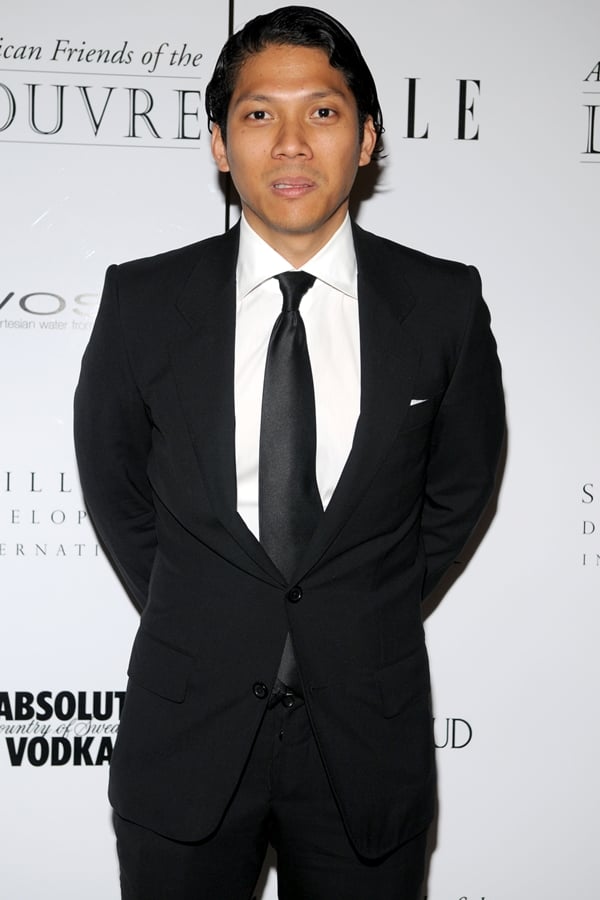
4. Robbie Antonio (Philippines) Among the biggest art collectors in the Philippines, this young real estate tycoon began by amassing portraits of himself by the likes of Marilyn Minter, Julian Schnabel, and the Bruce High Quality Foundation to adorn his Rem Koolhas-designed Manila home. Recently, Antonio transitioned to blue chip purchases by artists such as Francis Bacon, Willem de Kooning, Andy Warhol, and Takashi Murakami. Additionally, Antonio has also moved into prefab architecture by collaborating with design giants like the Campana Brothers and the lateZaha Hadid.
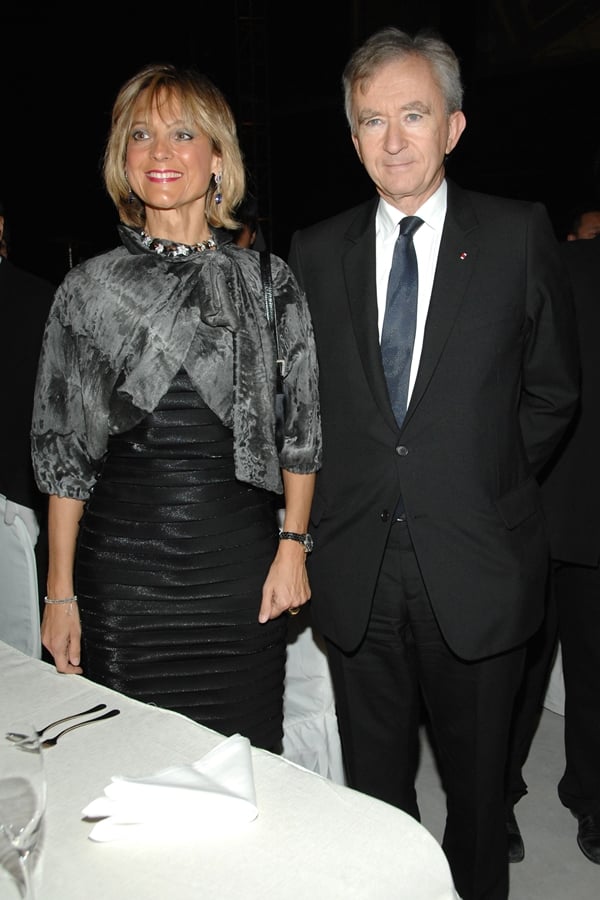
5. Hélène and Bernard Arnault (France) Chairman and CEO of the French luxury-products conglomerate LVMH, Arnault has a net worth of $32.8 billion, making him the richest man in Europe, according to Bloomberg. In 2014, Arnault opened the Frank Gehry–designed Louis Vuitton Foundation in Paris, with commissioned works by the likes of Olafur Eliasson, Ellsworth Kelly, Sarah Morris, and Taryn Simon. His collection consists of many thousands of contemporary and modern artworks, including pieces by Agnes Martin, Pablo Picasso, and Yves Klein.
Bill and Maria Bell at Alex Israel’s studio. Photo courtesy Bill and Maria Bell.
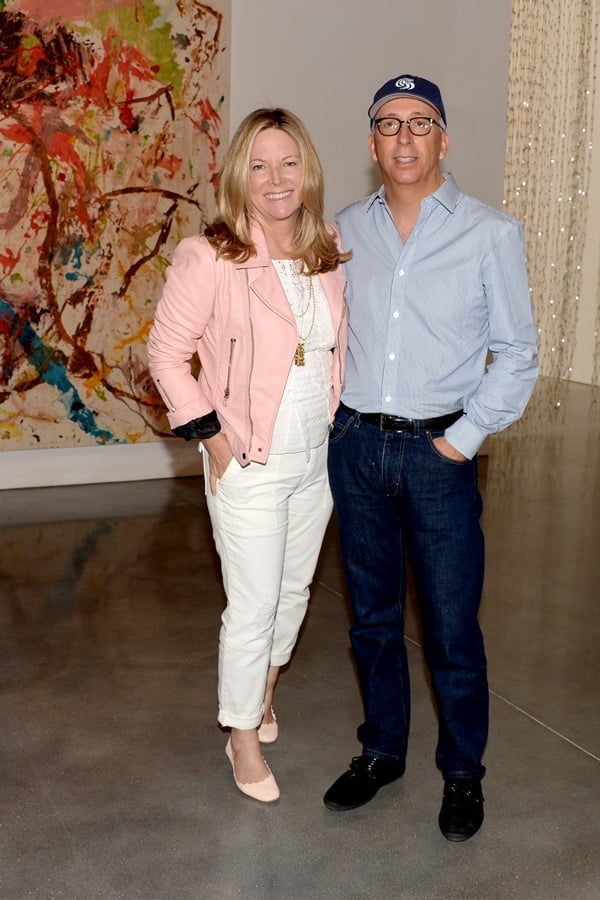
6. Bill and Maria Bell (United States) Early in their collecting career the Bells were drawn to Andy Warhol. Today, they have become best known as Jeff Koons’s biggest supporters—they bought the artist’s massive Play-Doh (1994–2014) sculpture and waited two decades for delivery. Much like when they started collecting in the 1990s, this power couple is well poised to take advantage of a softening market. In May they bought a $1.5 million Ed Ruscha painting at Christie’s postwar and contemporary art evening sale, substantially below it’s $2 million estimate.
Peter Benedek. Photo Alex J. Berliner/ABImages, courtesy United Talent Agency.
7. Peter Benedek (United States) Benedek, co-founder of United Talent Agency (which now represents artists), and his then-wife Barbara, a screenwriter (The Big Chill), began collecting 25 years ago when Peter bought himself a David Hockney painting as a birthday present from the now-defunct Corcoran Gallery in Santa Monica. Since then, he has amassed a first-rate store of artworks that he compulsively updates every year. In an email to artnet News, Benedek recently acknowledged adding works by the following artists to their extensive collection: William Kentridge, Jonas Wood, Lesley Vance, Ricky Swallow, Max Jansons, Tom Wesselmann, and Ella Kruglyanskaya. In his own words, his purchases over the last 12 months are “intergenerational and speak to many subjects.”
8. Lawrence Benenson (United States) NEW! The scion of a great New York real estate fortune, Benenson is an executive vice president at Benenson Capital Partners. His father was the storied art collector Charles Benenson; over a lifetime, he amassed an eccentric trove of artworks by figures such as Joan Miró and David Wojnarowicz. The tastes of Benenson fils also run to the eclectic: Lawrence collects historical documents (he owns a copy of the Emancipation Proclamation signed by Abraham Lincoln) as well as paintings and drawings by Henri Matisse, Kehinde Wiley, Gustave Doré, and Mark Lombardi. Additionally, Benenson serves on the board of New York’s Museum of Modern Art and the Ad Reinhardt Foundation.
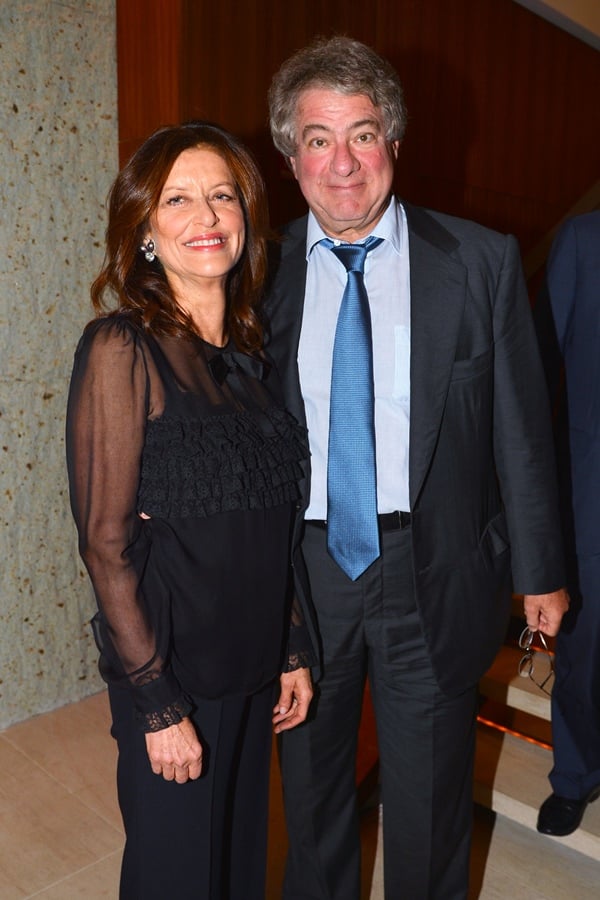
Debra Black and Leon Black. Photo Sylvain Gaboury/Patrick McMullan.
9. Debra and Leon Black (United States) Owner of Apollo Global Management, Phaidon Books, and Artspace Marketplace, Leon Black is reported to be worth $4.7 billion. His wife, Debra, is a Broadway producer. In 2012, Leon made waves when he purchased one of four existing versions of Edvard Munch’s The Scream for $120 million. Most recently, Leon was revealed to be Larry Gagosian’s secret buyer for Pablo Picasso’s contested plaster sculptureBust of a Woman (1931), for which the New York dealer paid $106 million. In 2014, the Blacks also bought a 17,000-square-foot Manhattan mansion previously occupied by the defunct Knoedler & Company for $50.25 million. Considering all their pricey treasures, it makes a swell private gallery.
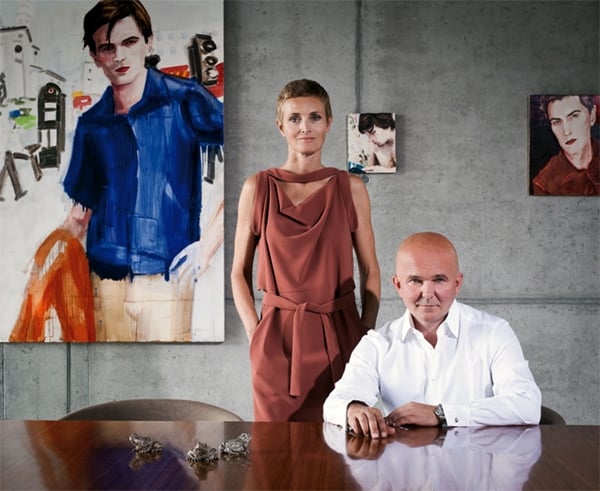
Christian Boros and Karen Boros at the Boros Collection. Photo John MacDougall/AFP/GettyImages.
10. Christian and Karen Boros (Germany) Located in a former World War II air raid shelter and S&M club, Christian and Karen Boros’ concrete abode is also home to the Bunker, an 80-room exhibition space for contemporary art that includes more than 700 artworks by artists such as Danh Vo, Ai Weiwei, Elmgreen & Dragset, Sarah Lucas, Rirkrit Tiravanija, Elizabeth Peyton, and Olafur Eliasson.
Norman Braman and Irma Braman. Photo Chris Ford/Patrick McMullan.
11. Irma and Norman Braman (United States) Besides being instrumental in bringing Art Basel to Miami in 2002, the Bramans are among the handful of local figures who ensure that that city’s private collections are among the best in the world. Much of their blue-chip collection—which includes paintings by Andy Warhol, Willem de Kooning, and Jasper Johns and the globe’s largest private holding of works by Alexander Calder—is on view at their spectacular Indian Creek Island residence. Since 2014, the Bramans have also been engaged in another large project: Funding the design and construction of South Florida’s newest museum, the Institute of Contemporary Art, Miami, set to open its new Design District flagship in December 2016, just in time for Art Basel in Miami Beach.
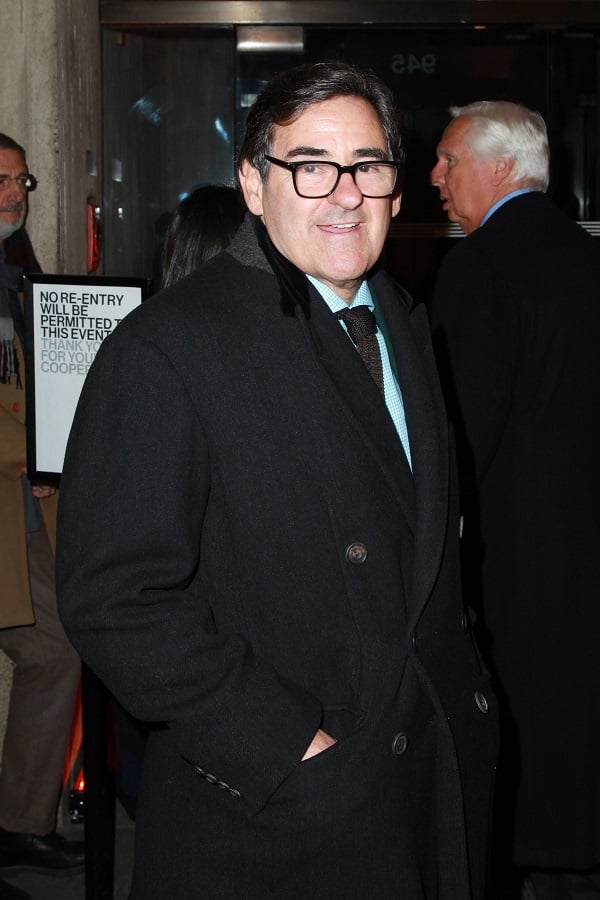
Peter M. Brant at the Montblanc De La Culture Arts Patronage Award ceremony at Kappo Masa, November 10, 2015, in New York. Photo Nicholas Hunt/Getty Images for Montblanc.
Eli Broad and Edythe Broad at Los Angeles’s the Broad in 2015. Courtesy photographer Jerod Harris/Getty Images.
13. Eli and Edythe Broad (United States) A fixture of top collector lists for many a year, the Broads further solidified their influential position with the opening of the Broad, their new $140 million, Diller, Scofidio + Renfro-designed contemporary art museum in Los Angeles. The museum boasts Yayoi Kusama’s Infinity Room (2013), Jordan Wolfson‘s creepy robot, as well as another two thousand Instagram-ready artworks. The collection showcases the couple’s blue-chip tastes—Edythe started collecting some 50 years before her husband—as well as thematic shows, like the Broad’s upcoming Cindy Sherman survey. “We look for quality, and for things that we think are going to be huge and historically important,” Eli told Haute Living in March. “I’m interested in whether it has social commentary.”
German art collector Frieder Burda poses next to a Pablo Picasso sculpture in the exhibition “Masterpieces of the Museum Frieder Burda” at the Granet museum in Aix-en-Provence. Courtesy photographer Gerard Julien/AFP/Getty Images.
14. Frieder Burda (Germany) Burda, who turned 80 this year, opened his eponymous Frieder Burda Museum in Baden-Baden in 2004. His collection has grown to include more than 1,000 works of mostly blue-chip art that include pieces by German Expressionists, Abstract Expressionists, and Teutonic contemporaries like Sigmar Polke and Gerhard Richter. In May, Burda made news for his deaccessioning of Mark Rothko’s No. 36 (Black Stripe) (1958) at Christie’s for $40.5 million. Yet Burda’s collection continues to grow. According to the German art magazine Monopol, the collector recently acquired Andreas Gursky’s photograph Rückblick (2015), which depicts Germany’s four living chancellors seated before Barnett Newman’s painting Vir Heroicus Sublimis (1950–51).
15. Richard Chang (United States) Regularly touted as one of Asia’s top collectors, Chang founded the Domus Collection, which is based both in New York and Beijing. Since then, the investment professional has become a key broker between the art communities of both East and West. Chang is a trustee of the Royal Academy in London and MoMA PS1 and the president of New York’s Performa. Additionally, he is the vice chair of the Tate’s International Council. Chang collects work from artists at all stages of their careers. The Domus Collection told artnet News that he’s recently been focusing on established German artists Anselm Kiefer and Sigmar Polke, mid-career American abstract painters such as Laura Owens and Jacqueline Humphries, and emerging artists including Harold Ancart and Kevin Beasley.
Pierre T.M. Chen. Courtesy of the Yageo Foundation.
16. Pierre T.M. Chen (Taiwan) Though he recently stepped down from being CEO of his electronics company, Chen has definitely not retired from collecting. In fact, the Taiwanese entrepreneur made his biggest purchase ever in at Christie’s in May, when he paid $26 million for the painting Swamped (1990) by Scottish painter Peter Doig. Other works in his Western-leaning collection include pieces by Georg Baselitz, Francis Bacon, Gerhard Richter, Cy Twombly, Marc Quinn, Andreas Gursky, and Mark Rothko. Reportedly, full-time staff help Chen buy his art. In 2014–15, some 75 works from his collection toured four Japanese museums in the exhibition “Guess What? Hardcore Contemporary Art’s Truly a World Treasure.”
Adrian Cheng. Courtesy photographer Eric Piermont/AFP/Getty Images.
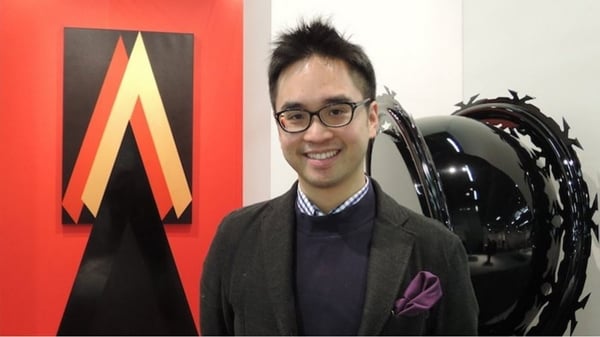
17. Adrian Cheng (China) Heir to a property-development fortune in Asia, the Hong Kong native is the founder of the K11 Art Foundation, which has staged exhibitions by artists like Olafur Eliasson, Damien Hirst, and Yoshitomo Nara at the foundation’s K11 Art Malls in Hong Kong and Shanghai. Cheng is on the board of directors of the West Kowloon Cultural District Authority, is a board member of the National Museum of China Foundation, a trustee of the Royal Academy, a member of Tate‘s International Council, and a member of the Centre Pompidou‘s International Circle. In March of this year, Cheng—who is among the world’s youngest billionaires—announced that he joined the board of directors of the Public Art Fund.
Patricia Phelps de Cisneros poses with the artwork Nylon Cube by Venezuelan artist Jesus Soto, part of the exhibition “Radical Geometry: Modern Art of South America from the Patricia Phelps de Cisneros Collection” at the Royal Academy of Arts in London, England. Courtesy of photographer Matthew Lloyd/Getty Images.
18. Patricia Phelps de Cisneros (Venezuela and Dominican Republic) Founded in the 1970s by Cisneros and her husband, Gustavo, the New York City and Caracas-based Colección Patricia Phelps de Cisneros (CPPC) is one of the world’s premiere collections of Latin American art. The collection ranges across ethnographic objects, colonial, modern, and contemporary art from the Americas. Additionally, Cisneros sits on the board of MoMA.
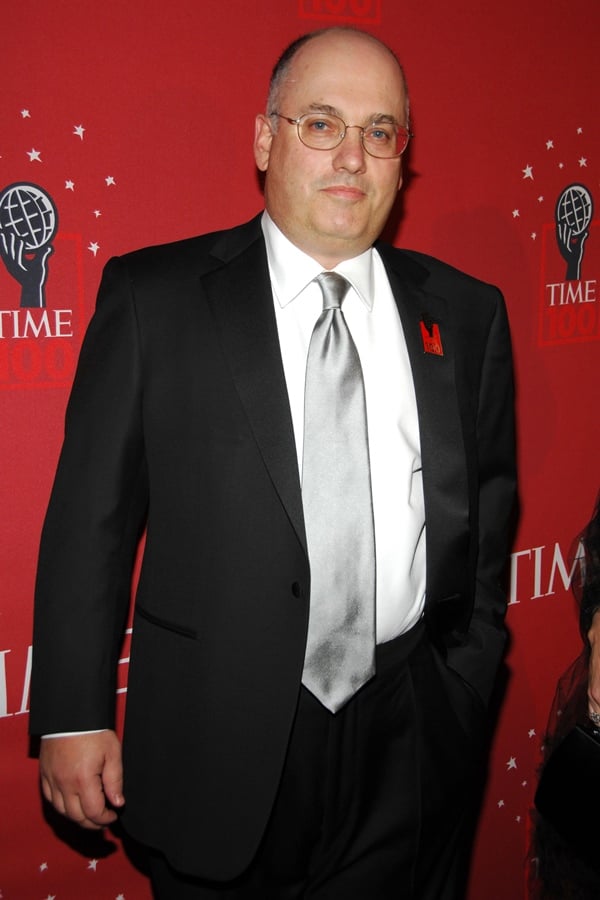
19. Steve Cohen (United States) The former hedge-fund manager has a history of using the art trade as a financial market—mainly by buying and selling high-priced artworks—but in January he went one further. He used his $1 billion store of art trophies to secure a personal loan from Morgan Stanley’s Private Bank. More recently, the billionaire—who bought Alberto Giacometti’s painted-bronze sculpture Chariot (1950) for $101 million at Sotheby’s in 2014—acquired 1.2 million Sotheby’s shares through his new company, Point72 Asset Management, making him the auction house’s fifth largest shareholder.
Galleries and auction houses are always searching for emerging art collectors who they can bring into the fold. With the art market boom in recent years, there’s been a proliferation of young international collectors with passion for art, and pocketbooks to back it up.
Below are 12 collectors who have been making names for themselves in the wild and ever-changing world of art.
1. Emma Hall Emma Hall comes by her love of art honestly—her parents are mega-collectors Andy and Christine Hall, whose appointment-only Vermont art museum, the Hall Art Foundation, features work by Anselm Kiefer, Georg Baselitz, and Joseph Beuys.
Hall got her start in the art world working at Christie’s, Sotheby’s, and Haunch of Venison and now manages special projects and communications at the family museum. She’s also passionate about painting. “I like to feel the artist’s presence in the work. I like to feel color and emotion in art,” she told Artinfo in 2012.
2. Robbie Antonio Real estate developer Robbie Antonio has filled his Manila home with a rapidly ballooning art collection filled with the likes of Damien Hirst, Francis Bacon, Takashi Murakami, and Jeff Koons. He’s been called “the biggest collector in the Philippines” by Larry’s List, refers to Marina Abramović as a pal, and hopes to surpass Peter Brant in portrait commissions from blue-chip artists.
“You see Peter Brant do this for Stephanie Seymour. [B]ut I do it for myself! I want to surpass that,” he told Vanity Fair in 2013.
3. Fabiola Beracasa Beckman Fabiola Beracasa Beckman, whose mother is Hearst publishing heiress Victoria Hearst, is a film producer, philanthropist, and creative director/co-owner of the Hole gallery, Kathy Grayson’s hip Bowery outfit. She also sits on the board of the Art Production Fund.
Needless to say, Beracasa also has an impressive art collection, which boasts names like Matthew Stone, Genesis P-Orridge, Rob Pruitt, and Aurel Schmidt.
4. Aarti Lohia Indian-born, Singapore-based Aarti Lohia has been collecting art for the past five years, assembling a trove of work by blue-chip Indian artists like Bharti Kher, M.F. Husain, Subodh Gupta, and Dayanita Singh, in addition to a growing number of artists based in Singapore and elsewhere.
“I look for imagination and inventiveness and am often drawn to pieces that have an overwhelming sense of memory—both visual and tactile,” she told the Straits Times.
5. Mohammed Afkhami Iranian-born financier and art lover Mohammed Afkhami, who has been collecting Middle Eastern contemporary art for over a decade, has been identified many times over as one of the Middle East’s major players.
“[A] friend of mine called me up and said, ‘Look, there’s a great Iranian art scene flourishing. Come and have a look at some of these galleries.’ So I went with him, and he took me to this gallery. And I bought my first pieces,” he told Ibraaz. “I mean these were pieces that were $300, $400, or $500. And in the West, a canvas costs much more than that. And I brought the pieces back, and I started getting a little bit into it.”
6. Daniela Hinrichs Daniela Hinrichs, a German curator, dealer, entrepreneur, and founder of online commerce platform DEAR Photography, has a keen eye for all things related to film.
Hinrichs designed the platform with the hope of inspiring first-time collectors to take the plunge. “Don’t let yourself become embroiled in discussions about what art is and isn’t. Buy the artwork you still love even after you’ve looked at it for the 100th time,” she advises on her site.
7. Amar’e Stoudemire Amar’e Stoudemire may be best known for his skills on the basketball court, but he’s made it clear that he’s also committed to making a name for himself as a “legit and serious” art collector.
Stoudemire, who was spotted around this year’s Art Basel in Miami Beach festivities, owns work by collector staples like Jean-Michel Basquiat and Andy Warhol, as well as Rob Pruitt, Retna, and Hebru Brantley.
8. Michael Xufu Huang Michael Huang, a Beijing-born collector and founder of non-profit museum M WOODS, is actually still a student at the University of Pennsylvania, which makes his regular pilgrimages to New York from museum and gallery openings relatively easy.
“I started collecting when I was sixteen,” he told Linda Yablonsky at Artforum.
9. Tiffany Zabludowicz Tiffany Zabludowicz is another college student who also started collecting at 16—though with the last name Zabludowicz, no one is too surprised.
She has quickly made a name for herself in the art world as not just a well-heeled collector, but also a curator, erstwhile MoMA PS1 intern, and occasional Artspace columnist.
10. Sharmin Parameswaran Malaysian-born curator Sharmin Parameswaran has been dubbed “one of the most eagerly watched art curators in the country” by local publication Women’s Weekly.
She’s following in the footsteps of her collector father, Dato N. Parameswaran, the former Malaysian ambassador to Vietnam. In 2012, she launched Interpr8 art space, an exhibition space in Kuala Lumpur featuring a large collection of Malaysian and Southeast Asian art.
11 & 12. Patrick and Lindsey Collins Patrick Collins, CEO of Texas-based Cortez Resources, and his wife Lindsey began buying art several years ago with a painting by Ryan McGinness, and now have an extensive collection featuring Tom Burr, Jill Magid, Dan Finsel, and Pedro Reyes.
“We really care about the artists and the relationships we’ve made—and helping people of our generation realize what they want to do in terms of their work,” Patrick told D magazine in 2012.
Today’s world is ever more globalized and increasingly interconnected—and that means the emergence of a new kind of multi-millionaire and billionaire with currency to spare (see The Top 10 Uber-Rich Art Collectors). Beyond their tendency to snap up properties of every shade, from penthouses to boats to businesses, this generation of tycoons, celebrities, and philanthropists are more regularly turning to another time-tested form of ritual consumption with a range of cultural benefits: art collecting. Be they heirs to Middle Eastern fortunes or young pioneers in the tech industry (see Meet 20 of the World’s Most Innovative Art Collectors), art collectors in the 21st century represent a demographic more widely varied than ever before.
To chronicle our times and these champions of the arts who hail from all corners of the planet and every possible background, artnet News has compiled the ultimate two-part list. Our roster of collectors features those who have been most active within the past 12 months and have shown a remarkable commitment to collecting.
We acknowledge that the lineup is heavily skewed toward male collectors based in the US, but beyond the usual suspects, we’ve done our best to cast a light on collectors you may not have yet heard about. We’re impressed by the number of influential women who made the cut (see The 100 Most Powerful Women in Art: Part One), as well as the marked contingent of younger Chinese men and women including Richard Chang, David Chau and Kelly Ying, Adrian Cheng, and Lin Han.
Some collectors are profiled in depth, while others, our “Collectors to Watch”—including emerging connoisseurs, those who are operating under the radar, and those who were once very active even if they’ve been quieter in recent years—are incorporated by name only.
Organized alphabetically, the index is the culmination of a three-month process that began with a poll of experts in the industry—including dealers, art advisers, and other insiders—and involved the efforts of staff and freelance writer Emily Nathan. (See Artnet News Top 200 Art Collectors Worldwide For 2015, Part Two).
We hope you find it useful!
Roman Abramovichand Dasha Zhukova (Russia) Moscow-born Dasha Zhukova opened the Garage Center for Contemporary Culture in 2008 in Moscow (see Dasha Zhukova to Debut Moscow’s Rem Koolhaas–Designed Garage Museum June 12), and, with her partner Roman Abramovich (the owner of England’s Chelsea Football Club) she is now developing “New Holland,” a 19-acre island in Saint Petersburg, into a similar creative hub. Together, they recently bought the world’s largest collection of works by Ilya Kabakov (the priciest living Russian artist). Her collection is now legendary, containing thousands of mostly contemporary artworks. Her husband seems to prefer modern and Impressionist art, if auction records are any guide.
Robbie Antonio. Photo: Courtesy of Clint Spaulding/ Patrick McMullan.
Robbie Antonio (Philippines) Real estate developer Antonio’s Manila home was designed by Rem Koolhaas—the first residential commission the architect had taken on in 15 years—and it houses the Filipino collector’s private collection. His current obsession is a series of portraits of himself that he has commissioned from some of the world’s hottest contemporary artists (he has already paid $3 million for the two dozen that have been completed), including Julian Schnabel, Marilyn Minter, David Salle, Zhang Huan, the Bruce High Quality Foundation, and Takashi Murakami.
Bernard and Hélène Arnault. Photo: Courtesy of Billy Farrell/Patrick McMullan.
Hélène and Bernard Arnault (France) Chairman and chief executive officer of the Louis Vuitton Foundation, Arnault is the richest man in France. His newest creation, the Frank Gehry–designed Louis Vuitton Foundation, opened in the Bois de Boulogne this past October (see As a Museum, Frank Gehry’s Fondation Louis Vuitton in Paris Disappoints), with commissioned works by the likes of Olafur Eliasson, Ellsworth Kelly, Sarah Morris, and Taryn Simon. His collection spans many thousands of contemporary and modern artworks.
Maria and Bill Bell. Photo: patrickmcmullan.com
Bill and Maria Bell (United States) Maria, the former head writer of CBS’s The Young and the Restless, a chair of the National Art Awards, and a former board co-chair of the Museum of Contemporary Art, Los Angeles (MOCA), got her start collecting modestly priced George Hurrell photos, and has always favored the work of idiosyncratic contemporary producers like Francesco Vezzoli and Mark Ryden. Her husband Bill’s taste tends toward the more iconic, including works by Marcel Duchamp. Early in their collecting career together, the Bells were drawn to Andy Warhol, but, as they recently told the New York Observer, they wanted to look to more contemporary producers—and deemed Jeff Koons an appropriate choice. These days, they have amassed a substantial collection of works by Koons, along with many other mega names.
Peter Benedek. Photo: patrickmcmullan.com
Peter Benedek (United States) Peter Benedek, co-founder of United Talent Agency and one of Hollywood’s most powerful agents, began collecting art some 20 years ago, and has since filled nearly all the walls of his Brentwood home and his Beverly Hills office with works by some of the biggest names in modern and contemporary art—from David Hockney and Gerhard Richter to Alex Katz, Milton Avery, and even Francis Picabia and Giorgio Morandi. He is reported to have purchased a John Currin nude long before the painter was a hot name, and an Alice Neel portrait of dealer Robert Graham—which he purchased at auction—still hangs in his office: “It’s great to have an agent looking at me every day,” he told the Hollywood Reporter.
Debra and Leon Black. Photo: patrickmcmullan.com
Debra and Leon Black (United States) Owner of Apollo Global Management, Phaidon Books, and Artspace Marketplace, so-called “buyouts man” Black is reported to have a fortune of $5.4 billion. In 2012, he made waves when he purchased one of four existing versions of Edvard Munch‘s The Scream for $119.9 million—at the time, the highest price ever paid for a work of art at an auction.
Christian and Karen Boros. Photo: Courtesy FvF/ Wolfgang Stahr.
Christian and Karen Boros (Germany) In 2003, ad agency founder and publisher Christian Boros purchased a former Nazi air raid shelter in central Berlin, and transformed it into the Bunker, an 80-room exhibition space for contemporary art. Featured artists from Boros’s personal collection of some 700 works include contemporary stars like Elmgreen & Dragset, Sarah Lucas, and Rirkrit Tiravanija, classics like Olafur Eliasson (a Boros favorite, with 30 works in his collection), Franz Ackermann, Wolfgang Tillmans, Ed Ruscha, Damien Hirst, and Terence Koh, and even members of a new generation of Berlin-based artists, including Thea Djordjadze, Alicja Kwade, Klara Lidén, Michael Sailstorfer, and Danh Vo.
Norman and Irma Braman. Photo: patrickmcmullan.com
Irma and Norman Braman (United States) Since they began collecting in 1979—they fell in love with sculptures by Alexander Calder and Joan Miró at the Maeght Foundation in southern France, as the story goes—auto-industry magnate Braman and his wife Irma have built a veritable empire of modern and contemporary art. Dividing their residences among France, Colorado, and Florida, the couple helped establish Art Basel in Miami Beach in 2002, and they are now single-handedly funding the design and construction of South Florida’s newest major museum, the Institute of Contemporary Art, Miami.
Peter Brant.Photo: patrickmcmullan.com
Peter Brant (United States) The owner of Interview magazine (which he bought directly from its founder, Andy Warhol), as well as Art in America and Antiques, and the creator of the Brant Foundation in Greenwich, Connecticut (see Is the Brant Foundation a Tax Scam or an Art Investment Vehicle?), Brant is known for his blue-chip collection of primarily American art, though his recent acquisitions include Vancouver artist Steven Shearer. Brant made news recently when he purchased artist Walter de Maria’s 16,400-square-foot East Sixth Street studio and home for $27 million (see Peter Brant Paid $27 Million for Walter De Maria’s Old Studio); he has already hosted a show by Dan Colen in the space (see Peter Brant Hosts Dan Colen Show in Walter De Maria Studio), and many speculate that he will transform it into an exhibition venue.
*More Collectors To Watch: Paul Allen Basma Al Sulaiman Sheikha Al Mayassa bint Hamad bin KhalifaAl-Thani Marc Andreessen Laura and John Arnold Camilla Barella Swizz Beatz Claudia Beck and Andrew Gruft Robert and Renée Belfer Lawrence Benenson
Frieder Burda. Photo: Courtesy of Joe Schildhorn/ Patrick McMullan.
Frieder Burda (Germany) The son of a renowned German publisher and art collector, Burda bought his first picture, a Lucio Fontana, in his early 30s, and in 2004 he opened his Frieder Burda Museum in Baden-Baden. The collection has now grown to include more than 1,000 works of art. Like his father, Burda focuses on established modern movements such as German Expressionism (Ernst Ludwig Kirchner, August Macke, Max Beckmann) and Abstract Expressionism (Jackson Pollock and Willem de Kooning), and he has acquired a substantial collection of works by his German contemporaries, among them Sigmar Polke, Georg Baselitz, and Gerhard Richter.
Richard Chang. Photo: patrickmcmullan.com
Richard Chang (United States) American-Chinese investment professional Richard Chang, the founder of the Domus Collection, is a trustee of the Royal Academy in London, a member of Tate’s International Council and its Asia-Pacific Acquisitions Committee, and a trustee of MoMA PS1 and the Whitney Museum in New York, where he is also co-founder and chair of the performance committee. Dividing time between New York and Beijing, he is considered key in bridging Western and Asian art; he often sponsors special projects, such as Beijing-based artist Huang Ran’s feature film The Administration of Glory in 2013 (which was selected for the Palme d’Or at Cannes in 2014—see 31-Year-Old Artist Ran Huang Selected for Cannes’ Palmes d’Or), and Pipilotti Rist’s first exhibition in China, at the Times Museum in Guangzhou.
Kim Chang-il (Korea) Founder of the recently launched Arario Museum, Kim Chang-il is one of Korea’s top gallerists as well as collectors, and is also an artist. His collection began with an interest in contemporary and modern Korean artists, but, as reported by the Huffington Post, a visit to MOCA in Los Angeles in 1981 inspired him to expand his collection. His holdings now number around 3,700 pieces, and include work from Korean contemporaries as well as YBAs, members of the Leipzig School, and young artists from China, India, and Southeast Asia, as well as respected big-name artists from the West.
David Chau and Kelly Ying (China) Based in Shanghai, David Chau and his wife, Kelly Ying, acquired the bulk of their wealth from David’s fleet-management company, and estimate that they spend around $1.5 million annually on art acquisitions. Chau set up a $32-million art investment fund when he was 21, and is the financial backer of two galleries, Leo Xu’s and Simon Wang’s Antenna Space. He is also the co-founder, with Ying, of Shanghai’s newest art fair, Art021. Their personal collection is anchored by work by three young Chinese artists, Liu Wei, Xu Zhen, and Yang Fudong, as well as an extensive selection of video art.
Pierre Tm Chen. Photo: Courtesy of Sotheby’s/ Andrew Loiterton.
Pierre T.M. Chen (Taiwan) Chen made his first purchase in 1976 while still a student—a wooden sculpture by Chinese artist Cheung Yee. It took him a year and a half to save up the funds to do so. Today, the computer engineer’s extensive collection features hundreds of paintings and sculptures by blue-chip artists including Mark Rothko, Willem de Kooning, Henry Moore, Les Lalanne, Antony Gormley, Cai Guo-Qiang, and Jeff Koons. He is currently most excited by Western contemporary art, and purchases rather emotionally: he is said to have bought an untitled Cy Twombly because it made him feel “calm” and a yellow Warhol Fright Wig because he found it “so fresh.”
Adrian Cheng. Photo: Courtesy of Larry’s List.
Adrian Cheng (China) One of the world’s youngest billionaires, Cheng is heir to a property-development fortune in Asia. He graduated from Harvard and has gone on to found the nonprofit K11 Art Foundation, which supports art villages in Wuhan and Guiyang, China; its collection focuses on international artists, such as Yoshitomo Nara and Olafur Eliasson, while Cheng’s own personal collection includes work by Chinese artists such as Zhang Enli. In 2012 Cheng was also invited to join Tate’s Asia-Pacific Acquisitions Committee.
Kemal Has Cingillioglu (United Kingdom) Son of Turkish financier Halit Cingillioglu, Kemal Has Cingillioglu serves as a member of the European advisory board at Christie’s. He made headlines this past year when he purchased Cy Twombly’s 1960s work Untitled (Rome) for $4.4 million at Christie’s.
Patricia Phelps de Cisneros. Photo: patrickmcmullan.com
Patricia Phelps de Cisneros (Venezuela and Dominican Republic) Phelps de Cisneros is one of the world’s most prominent collectors of Latin American art, and her trove contains some 2,000 works ranging across colonial, modern, and contemporary periods, along with ethnographic objects from the Americas. She sits on the board of MoMA, and London’s Royal Academy recently presented an exhibition of 90 works in geometric abstraction that were drawn from her holdings.
Steven Cohen. Photo: patrickmcmullan.com
Steven Cohen (United States) Billionaire former hedge fund manager Steven Cohen, who is reportedly worth some $11.1 billion, is said to spend 20 percent of his income on art, with a collection that famously includes a Pollock drip painting and Damien Hirst’s iconic shark piece, which he bought from Charles Saatchi for $8 million in 2004. In 2006, he offered to buy Picasso’s Le Rêve from Steve Wynn for $139 million, but Wynn accidentally put his elbow through the painting and the deal was off until last year, when Cohen finally purchased the painting, now repaired, for $155 million. He was also the secret buyer of the Alberto Giacometti sculpture Chariot in November, which he bought at Sotheby’s for a near-record $100,965,000.
Carlos and Rosa de la Cruz. Photo: patrickmcmullan.com
Rosa and Carlos de la Cruz (United States) Carlos de la Cruz is the chairman of a $1 billion-per-year business empire that includes Coca-Cola bottling plants in Trinidad and Tobago and Puerto Rico. Along with his wife Rosa, he is known for staging state-of-the-art annual exhibitions that coincide with Art Basel Miami Beach. These were initially held in their private Miami residence, but are now staged at their eponymous three-story, 30,000-square-foot art space, which they opened in 2009. The couple is keen on acquiring works from across the wide range of contemporary American production, most recently purchasing pieces by Dan Colen and Nate Lowman.
*More Collectors To Watch:
Nicolas Berggruen Jill and Jay Bernstein Ernesto Bertarelli James Brett Jim Breyer Christian Bührle Monique and Max Burger Valentino D. Carlotti Edouard Carmignac Trudy and Paul Cejas
Dimitris Daskalopoulos (Greece) Beyond his vast collection of contemporary art, Greek food and beverage entrepreneur Daskalopoulos is a member of the board of trustees of the Solomon R. Guggenheim Foundation, Tate International Council, the Director’s Vision Council of the Museum of Contemporary Art Chicago, and the Leadership Council of New York’s New Museum. He is also a founding partner of the Whitechapel Gallery’s Future Fund. In 2014 he was honored by Independent Curators International (ICI) with the Leo Award, which celebrates a “visionary” approach to collecting. He is also a champion of the contemporary art scene in his home country, and recently founded a nonprofit, NEON, committed to bringing contemporary culture to everyone in Greece.
Zöe and Joel Dictrow. Photo: patrickmcmullan.com
Zöe andJoel Dictrow (United States) These long-time West Village residents, Zoe a former magazine advertising manager and Joel a former Citigroup executive, have lived in the same apartment for four decades, though they eventually purchased two neighboring apartments to accommodate their expanding art collection. They are known for their support of emerging artists, but their holdings include work by established producers like Gerhard Richter, Robert Gober, Cindy Sherman and Sarah Sze.
George Economou. Photo: Courtesy of Nicholas Hunt/ Patrick McMullan.
George Economou (Greece) The Greek shipping magnate has a predilection for paintings and drawings, particularly of the 20th-century German and Austrian persuasion, and he frequently purchases work by lesser-known artists, or minor works by big-name producers, from Picasso, Twombly and Magritte to Kees van Dongen. A prolific collector, he acquires between 150 to 200 works a year, and usually chooses to go through smaller auction houses and galleries based in Germany and Austria rather than Sotheby’s or Christie’s.
Alan Faena. Photo: Courtesy Patrick McMullan/ Patrick McMullan.
Alan Faena (Argentina) Argentina’s most successful hotelier and real estate developer, Faena is an avid collector of Latin American art. In December of 2015, he aims to debut his new exhibition space, a Rem Koolhaas–designed structure called the Faena Forum, opening in Miami.
Harald Falckenberg (Germany) One of the world’s most respected art collectors, Falckenberg has received the Art Cologne Prize and the Montblanc de la Culture Arts Patronage Award, and published numerous books on art. Known for his ability to stay ahead of the art market, he was among the first collectors to purchase works by now-major figures like Martin Kippenberger, Richard Prince, and Jonathan Meese, and his collection comprises over 2,000 pieces, shown in a 65,000-square-foot former factory building in Hamburg in collaboration with Deichtorhallen/Hamburg.
Mark Falcone and Ellen Bruss.
Mark Falcone and Ellen Bruss (United States) Real-estate developer Falcone and his wife Ellen Bruss live next door to the Museum of Contemporary Art Denver in a home designed for them by architect David Adjaye. In recent years they have become avid collectors of Mexican art, and their collection now includes works by Gonzalo Lebrija, Eduardo Sarabia, and Federico Solmi, as well as Denver artists Stephen Batura, David Zimmer, Adam Milner, Bill Stockman, and Mary Erhin.
Amy and Vernon Faulconer. Photo: patrickmcmullan.com
Amy and Vernon Faulconer (United States) Founded by oil and gas magnate Vernon Faulconer and his wife Amy, the Amy and Vernon Faulconer Collection contains painting, sculpture, photography, video, and installation works made from 1945 to the present, with notable contributions by such artists as Cecily Brown, John Chamberlain, Francesco Clemente, Donald Judd, Anish Kapoor, Anselm Kiefer, Martin Kippenberger, Bridget Riley, James Turell, and Kara Walker, among many others. Together with his friends and fellow Texan super-collectors the Rachofskys, the Falconers opened the Warehouse in 2012, in part to accommodate works that were too large for the Faulconer’s private home.
Howard Farber. Photo: patrickmcmullan.com
Howard and Patricia Farber (United States) The Farbers fell in love with the art of Cuba during a visit to the island in 2001, and have since created a stunning collection of some 200 pieces by artists including Belkis Ayón, Abel Barroso, Tania Bruguera, Los Carpinteros, Sandra Ramos, Duvier del Dago, Carlos Garaicoa, René Peña, and Rocío García.
Marilyn and Larry Fields. Photo: patrickmcmullan.com
Larry and Marilyn Fields (United States) Lawyer and former commodities trader Larry and his wife Marilyn, one of Chicago’s most prominent collecting couples, have amassed an array of some 500 objects from almost 300 living artists, 150 of which are installed in their private residence, and many of which have a political bent. The collection includes many pieces by African-American artists such as Kara Walker, Glenn Ligon, Mark Bradford, and Theaster Gates, whom they have been collecting in depth. Recent acquisitions include works by David Hammons, Jim Hodges, and Christopher Wool.
*More Collectors To Watch
Marie Chaix Michael and Eva Chow Frank Cohen Michael and Eileen Cohen Isabel and Agustín Coppel Anthony D’Offay Theo Danjuma Hélène and Michel David-Weill Antoine de Galbert Ralph DeLuca
Amanda and Glenn Fuhrman. Photo: patrickmcmullan.com
Amanda and Glenn Fuhrman (United States) Fuhrman, co-managing partner of MSD Capital, studied art history and was recently listed by Business Insider among the most serious art collectors on Wall Street. He is a trustee of the MoMA, is a trustee of Tate Americas Foundation, is a board member of the Institute of Contemporary Art in Philadelphia, and is founder of The FLAG Art Foundation in New York.
David and Danielle Ganek. Photo: patrickmcmullan.com
Danielle and David Ganek (United States) A former equity trader for SAC Capital and a trustee of the Guggenheim, Ganek and his wife, editor and novelist Danielle, have a sprawling art collection that includes work by Richard Prince, Diane Arbus, Jeff Koons, Cindy Sherman, John Currin, and Mike Kelley. David bought his first work of art at the age of 17, and has since gone on to commission work from mega-hot contemporary artists such as Ed Ruscha, whom he hired to create a painting incorporating the word “Level” for the walls of his firm’s Greenwich headquarters in 2003.
Ingvild Goetz (Germany) Former gallerist Ingvild Goetz began to collect media art in the 1990s, and today she owns one of the largest private collections of video art and media works in the world. Her Goetz Collection, housed in a private museum designed by Herzog & de Meuron in Munich, is said to contain around 5,000 works of contemporary art—many of them by emerging artists and nearly half of them by women.
Ken Griffin. Photo: patrickmcmullan.com
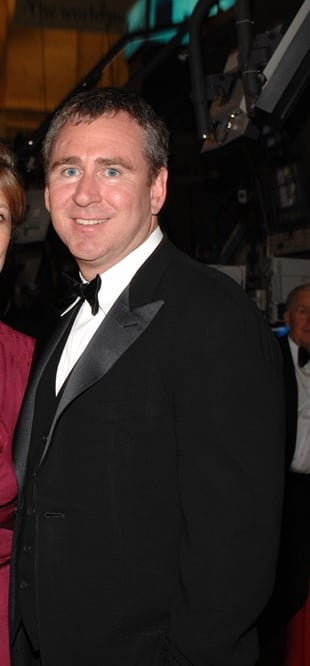
Ken Griffin (United States) Chicago-based Griffin, who recently divorced his wife Anne Dias (a board member at the Museum of Modern Art, a trustee of the Foundation for Contemporary Art and the Whitney Museum), has reportedly only ever sold one artwork from his collection. Head of the $20 billion investment firm Citadel, Griffin is extremely particular when it comes to acquisitions, and only buys masterpieces that he feels can hold their own alongside the few dozen pieces he already owns by Paul Cézanne, Claude Monet and Jasper Johns. (In 2006, he paid David Geffen $80 million for Jasper Johns’s 1959 painting False Start—a record price at the time for a living artist.)
Agnes GundPhoto: Owen Hoffmann/Patrick McMullan
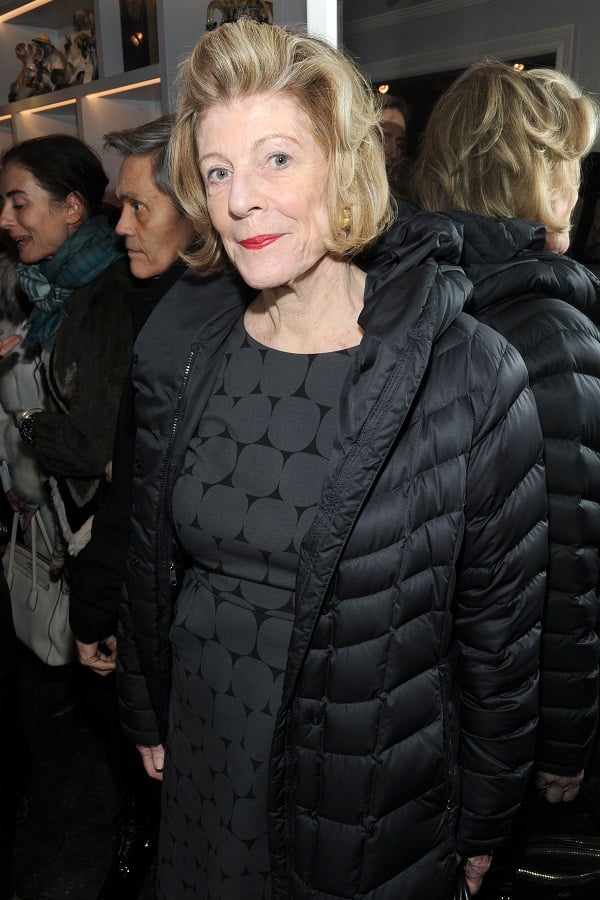
Agnes Gund (United States) Beloved art patron Agnes Gund is practically New York’s philanthropist-in-chief; she once told the New York Times that she gives away “more money than I really have,” not only to art organizations but also to causes like sex trafficking and abortion rights. Her 2,000-work collection includes works by artists like Jasper Johns, Ellsworth Kelly, Roy Lichtenstein, and Frank Stella, but she’s also known to collect female and black artists, including Lynda Benglis, Teresita Fernandez, and Kara Walker, and lesser-known artists like the Scottish Richard Wright, from whom she commissioned a mural on her dining room ceiling. Among her causes, too, is one that might groom the next generation of aspiring artists and collectors: Studio in a School, which she founded in the ’70s and which teaches art in under-resourced New York City schools.
Steven and Kathy Guttman (United States) Real-estate magnate Guttman’s collecting bug started when he would take his dog on walks in Washington, D.C., and check out the furniture in his neighbors’ houses—a practice which soon grew to include a penchant for buying everything from dressers, sofas, chairs, cabinets, and tables crafted by British and American folk artists to contemporary paintings and photographs. Today, he and his wife Kathy have a more than 500-piece collection of art including conceptual, LED, and wooden works by Andreas Eriksson, Jim Campbell, Analia Saban and Cheyney Thompson, among many others, stored among houses and storage spaces in Paris, New York and Maryland—including his $70-million, state-of-the-art storage facility in Long Island City, named “UOVO,” Italian for “egg,” in reference to the fragility of the space’s precious cargo.
Andrew and Christine Hall (United States) The British-born Hall, a former Citigroup trader and hedge fund manager who also dabbles in organic farming, and his wife, Christine, have a collection of postwar and contemporary art that includes works by Eric Fischl, A. R. Penck, Ed Ruscha, Andy Warhol, Franz West and Malcolm Morley. In 2012, they opened the Hall Art Foundation in Vermont, in exhibition partnership with the Massachusetts Museum of Contemporary Art, and they are working to organize a long-term installation of artworks by Anselm Kiefer from their collection. Most recently, the Halls have been busy converting a castle in Germany, the former home and studio of Georg Baselitz, into a museum that will open next year.
Lin Han (China) Although he has only been collecting for a few years, Han—who studied at a secondary school in Singapore before pursuing a degree in animation design at Northumbria University in the United Kingdom —recently opened the M Woods Museum with his wife Wanwan Lei, in the middle of Beijing’s art district, to show off his personal collection of over 200 artworks. Lei studied arts administration at China’s Central Art Academy and Columbia University in New York; Han’s first art purchase was a Zeng Fanzhi painting in 2013, and he has recently purchased work by such artists as Tracey Emin, Kader Attia and Chen Fei.
Henk and Victoria de Heus-Zomer (Holland) Henk and Victoria de Heus-Zomer, who made their fortune in the cattle-food industry, began collecting art in 1989, when they moved into a new home and reportedly needed something “to fill the empty walls.” They have since anticipated many trends in the market—acquiring works by such artists as Zhang Xiaogang and Ai Weiwei long before the international art world took notice of them—and they have become avid collectors of other contemporary Chinese artists as well. Theirs is now one of the largest contemporary art collections in the Netherlands.
Grant Hill. Photo: Barry Gossag
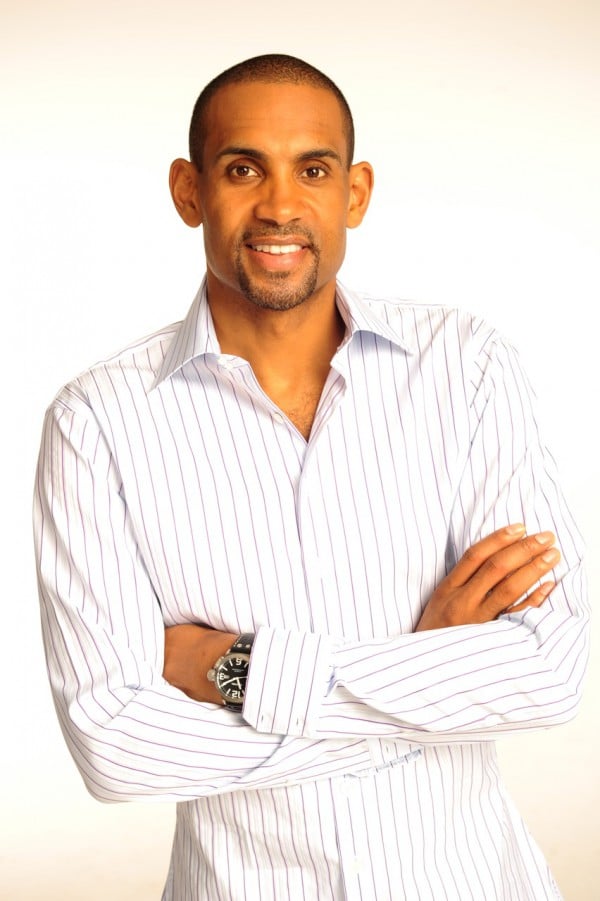
Grant Hill (United States) Seven time NBA All-Star Grant Hill was first introduced to art by his father. For years he has been considered one of the world’s leading collectors of African American fine art, with a collection that includes work by Elizabeth Catlett, Romare Bearden, Hughie Lee-Smith, John T. Biggers, Phoebe Beasely, Malcolm Brown, Edward Jackson, John Coleman and Arthello Beck, Jr. His collection was the source of a multi-city touring show “Something All Our Own,”which was seen in seven cities, including at the Nasher Museum of Art at Duke University, his alma mater. Hill, who has amassed a major collection, remains an active collector and philanthropist.
Maja Hoffmann. Photo: Courtesy of Will Ragozzino/ Patrick McMullan.
Maja Hoffmann (Switzerland) Founder of the LUMA Foundation and daughter of Luc Hoffmann of the Hoffmann-La Roche pharmaceutical fortune, Hoffmann is a Tate trustee, and she sits on the boards of the Palais de Tokyo, New York’s New Museum and CCS Bard, to name just a few. In July of 2013, her Foundation was granted permission to transform a 20-acre former train station in Arles, France, into a new art campus, designed by Frank Gehry and slated for completion in 2018.
Erika Hoffmann-Koenige. Photo: Courtesy of the Hoffmann Collection.
Erika Hoffmann-Koenige (Germany) Collecting since the 1960s, Erika Hoffmann-Koenig moved to Berlin with her late husband Rolf, a property developer, shortly after German unification in 1990, and installed their collection of largely conceptual contemporary art in their private residence, which they set up in a former sewing machine factory. Occasionally open to the public, their international collection ranges across all mediums; it was founded with works from the Italian Arte Povera movement and the Zero group (their first purchase, in 1968, was a sculpture by the Greek artist Vlassilakis Takis), and also features a substantial collection of Soviet Constructivist works, as well as works by Blinky Palermo, John Bock, Lawrence Wiener, and Andy Warhol, among many others.
*More Collectors to Watch
Tiqui Atencio Demirdjian Beth Rudin DeWoody Leonardo DiCaprio Mandy and Cliff Einstein Eric Diefenbachand JK Brown David C. Driskell Mandy and Cliff Einstein Rebecca and Martin Eisenberg, Ginevra Elkann Tim and Gina Fairfax Dana Farouki
Michael and Susan Hort. Photo: courtesy of David Willems Photography.
Michael and Susan Hort (United States) One of New York’s most respected collecting couples (see Five Major Art Collectors Reveal Their Holiday Wish Lists)—with a reputation as bold patrons of young and emerging artists, some of whom do not even have gallery representation when the Horts begin buying—Susan and Michael Hort continue to install selections from their holdings of some 3,000 works between their four-floor Tribeca home and their rural New Jersey abode. For the past 13 years, they have opened their Tribeca space to a select crowd of VIPs and art aficionados during Armory Week (see Want a Peek Inside the Exclusive Hort Family Collection?); curated by Jamie Cohen Hort, their daughter-in-law (married to their son, Peter Hort, who together are a notable young collecting couple), the viewings feature works by artists ranging from the likes of Cindy Sherman, Thomas Houseago, and John Currin to practically unknown talents, and can bring up to 3,000 visitors per day. The Horts continue to champion the arts through their own personal collecting and through their Rema Hort Mann Foundation, a nonprofit they set up in honor of their late daughter.
Guillaume Houzé. Photo: Courtesy of Bertrand Rindoff/ Getty Images.
Guillaume Houzé (France) Heir to his family’s chain of Galeries Lafayette department stores, Guillaume Houzé has been presenting artwork in La Galerie des Galeries, a space within the flagship branch, since 2005, along with his grandmother. His own collection includes works by Cyprien Gaillard, Wade Guyton, Tatiana Trouvé, Ugo Rondinone and David Noonan, and he is planning to open a permanent art foundation in Paris’s Marais district in 2016.
Wang Jianlin (China) The president of the Dalian Wanda Group, one of China’s largest real-estate developers—with a reported fortune of some $18 billion—Jianlin is currently battling entrepreneur Jack Ma for the title of richest man in China. He recently purchased a Picasso painting, Claude and Paloma, for $28.2 million (see Are Chinese Collectors Driving Global Art Market Rebound?).
Dakis Joannou. Photo: Courtesy of Yiorgos Kaplanidis.
Dakis Joannou (Greece) Greek-Cypriot billionaire industrialist and founder of the DESTE Foundation of Contemporary Art in Athens (as well as its outpost on the island of Hydra), Joannou has been assembling a blue-chip collection of contemporary art since the mid-1980s. Although his enormous holdings cross genres, periods, and geographies, including Baroque figurines, Cypriot antiquities, couture, drawings, and modernist furniture, his more contemporary interests include the work of such artists as Andro Wekua, Seth Price, Tauba Auerbach, Haim Steinbach, William Kentridge, and Pawel Althamer, among others.
Alan Lau (China) A member of the Asia-Pacific Acquisitions Committee at Tate London and of the board at nonprofit art space Para Site in Hong Kong—and a fixture on the art-conference circuit—Lau is one of the most influential Asian art collectors active today. He started collecting under 10 years ago, and his vast collection of Asian and Western art includes names like Nam June Paik, Ai Weiwei, Cao Fei, Lee Kit, Tsang Kin-Wah, Kwan Sheung Chi, Chow Chun Fai, Tozer Pak, and Olafur Eliasson, among others. (Lau also made the cut for artnet News’ 2014 list of Most Innovative Art Collectors.)
Joseph Lau (China) With a fortune recently estimated by Forbes at $4.3 billion, Chinese real-estate investor Joseph Lau started collecting more than 30 years ago, and is celebrated for his collection of modern and contemporary art, especially for his Warhols. He is best known for having purchased a 1972 iconic portrait of Mao by Warhol for $17.3 million at Christie’s New York in 2006; and Paul Gauguin’s Te poipoi (Le matin) (1892), which he bought for $39.2 million at Sotheby’s in November 2007.
Raymond Learsy and Melva Bucksbaum. Photo: patrickmcmullan.com
Melva Bucksbaum and Raymond Learsy (United States) Washington, D.C.–born Bucksbaum—who originally wanted to be an artist—and her second husband, former commodities trader Raymond J. Learsy, are best known for collecting contemporary art, but their collection includes everything from Peter Paul Rubens to James Rosenquist. The couple recently purchased The Hunting Party by Rosa Loy and Neo Rauch, and they are always adding to their collection of works by Laurie Simmons, a shared favorite. Bucksbaum is the patron behind the Whitney Museum’s Bucksbaum Award, which gives a $100,000 grant and a Whitney solo show to one lucky winner in each Whitney Biennial (see Zoe Leonard Wins Whitney’s Bucksbaum Award With Her Giant Camera Obscura).
Agnes and Edward Lee (United Kingdom) A principal in the London-based real-estate portfolio Princeton Investments, which has an estimated worth of $96 million, Edward Lee and his wife are quiet but avid collectors who like to take risks. They tend to favor edgy contemporary work by international producers such as Wilhelm Sasnal and Jim Hodges.
Aaron and Barbara Levine. Photo: patrickmcmullan.com
Aaron and Barbara Levine (United States) “A lot of people think conceptual art is a bunch of baloney,” Barbara recently told the Wall Street Journal, confessing that her taste has always been for more minimal art, while her husband, Aaron, has a predilection for Abstract Expressionists and Social Realism. Barbara and Mr. Levine, a personal-injury lawyer, live among four floors of photographs, books, drawings, sculptures, videos of performances and other creations by the likes of Robert Barry, On Kawara, Christopher Williams, and Marcel Duchamp, of whom they own 25 works.
Adam Lindemann. Photo: patrickmcmullan.com
Adam Lindemann (United States) New York collector and entrepreneur Adam Lindemann, known for the sassy insider column he penned for the New York Observer, has said that his introduction to the art world came through a former girlfriend, Cornelia Guest, who was a close friend of Andy Warhol. He founded uptown gallery Venus over Manhattan (see Adam Lindemann’s Venus Over Manhattan To Open in Los Angeles) and his wife, Amalia Dayan, co-founder of Upper East Side gallery Luxembourg & Dayan, live in a house designed by David Adjaye.
Eugenio López (Mexico) Mexican fruit-juice heir López—a trustee and vice chair of MOCA in Los Angeles—founded the largest private museum in Latin America, the Museo Jumex, in 2013, as a place to house selections from his personal collection (see Museo Júmex Appoints Julieta González Chief Curator and Interim Director in Aftermath of Hermann Nitsch Fiasco). He began to collect 20 years ago, initially buying historical pieces of 1960s art, then concentrating on Mexican and international work of his own generation, the ’90s. Designed by David Chipperfield, the museum houses some 2,000 works of López’s 2,700-piece collection, including many by American and European masters ranging from Cy Twombly and Robert Rauschenberg to Jeff Koons and Damien Hirst.
Susan and Leonard Feinstein Nicoletta Fiorucci Friedrich Christian (“Mick”) Flick Josée and Marc Gensollen Alan and Jenny Gibbs Noam Gottesman Florence and Daniel Guerlain Paul Harris Barbara and Axel Haubrok Alan Howard
Today’s world is ever more globalized and increasingly interconnected—and that means the emergence of a new kind of multi-millionaire and billionaire with currency to spare (see The Top 10 Uber-Rich Art Collectors). Beyond their tendency to snap up properties of every shade, from penthouses to boats to businesses, this generation of tycoons, celebrities, and philanthropists are more regularly turning to another time-tested form of ritual consumption with a range of cultural benefits: art collecting. Be they heirs to Middle Eastern fortunes or young pioneers in the tech industry (see Meet 20 of the World’s Most Innovative Art Collectors), art collectors in the 21st century represent a demographic more widely varied than ever before.
To chronicle our times and these champions of the arts who hail from all corners of the planet and every possible background, artnet News has compiled the ultimate two-part list. Our roster of collectors features those who have been most active within the past 12 months and have shown a remarkable commitment to collecting.
We acknowledge that the lineup is heavily skewed toward male collectors based in the US, but beyond the usual suspects, we’ve done our best to cast a light on collectors you may not have yet heard about. We’re impressed by the number of influential women who made the cut (see The 100 Most Powerful Women in Art: Part One), as well as the marked contingent of younger Chinese men and women including Richard Chang, David Chau and Kelly Ying, Adrian Cheng, and Lin Han.
Some collectors are profiled in depth, while others, our “Collectors to Watch”—including emerging connoisseurs, those who are operating under the radar, and those who were once very active even if they’ve been quieter in recent years—are incorporated by name only.
Organized alphabetically, the index is the culmination of a three-month process that began with a poll of experts in the industry—including dealers, art advisers, and other insiders—and involved the efforts of staff and freelance writer Emily Nathan. (See Artnet News Top 200 Art Collectors Worldwide For 2015, Part Two).
We hope you find it useful!
Roman Abramovichand Dasha Zhukova (Russia) Moscow-born Dasha Zhukova opened the Garage Center for Contemporary Culture in 2008 in Moscow (see Dasha Zhukova to Debut Moscow’s Rem Koolhaas–Designed Garage Museum June 12), and, with her partner Roman Abramovich (the owner of England’s Chelsea Football Club) she is now developing “New Holland,” a 19-acre island in Saint Petersburg, into a similar creative hub. Together, they recently bought the world’s largest collection of works by Ilya Kabakov (the priciest living Russian artist). Her collection is now legendary, containing thousands of mostly contemporary artworks. Her husband seems to prefer modern and Impressionist art, if auction records are any guide.
Robbie Antonio. Photo: Courtesy of Clint Spaulding/ Patrick McMullan.
Robbie Antonio (Philippines) Real estate developer Antonio’s Manila home was designed by Rem Koolhaas—the first residential commission the architect had taken on in 15 years—and it houses the Filipino collector’s private collection. His current obsession is a series of portraits of himself that he has commissioned from some of the world’s hottest contemporary artists (he has already paid $3 million for the two dozen that have been completed), including Julian Schnabel, Marilyn Minter, David Salle, Zhang Huan, the Bruce High Quality Foundation, and Takashi Murakami.
Bernard and Hélène Arnault. Photo: Courtesy of Billy Farrell/Patrick McMullan.
Hélène and Bernard Arnault (France) Chairman and chief executive officer of the Louis Vuitton Foundation, Arnault is the richest man in France. His newest creation, the Frank Gehry–designed Louis Vuitton Foundation, opened in the Bois de Boulogne this past October (see As a Museum, Frank Gehry’s Fondation Louis Vuitton in Paris Disappoints), with commissioned works by the likes of Olafur Eliasson, Ellsworth Kelly, Sarah Morris, and Taryn Simon. His collection spans many thousands of contemporary and modern artworks.
Maria and Bill Bell. Photo: patrickmcmullan.com
Bill and Maria Bell (United States) Maria, the former head writer of CBS’s The Young and the Restless, a chair of the National Art Awards, and a former board co-chair of the Museum of Contemporary Art, Los Angeles (MOCA), got her start collecting modestly priced George Hurrell photos, and has always favored the work of idiosyncratic contemporary producers like Francesco Vezzoli and Mark Ryden. Her husband Bill’s taste tends toward the more iconic, including works by Marcel Duchamp. Early in their collecting career together, the Bells were drawn to Andy Warhol, but, as they recently told the New York Observer, they wanted to look to more contemporary producers—and deemed Jeff Koons an appropriate choice. These days, they have amassed a substantial collection of works by Koons, along with many other mega names.
Peter Benedek. Photo: patrickmcmullan.com
Peter Benedek (United States) Peter Benedek, co-founder of United Talent Agency and one of Hollywood’s most powerful agents, began collecting art some 20 years ago, and has since filled nearly all the walls of his Brentwood home and his Beverly Hills office with works by some of the biggest names in modern and contemporary art—from David Hockney and Gerhard Richter to Alex Katz, Milton Avery, and even Francis Picabia and Giorgio Morandi. He is reported to have purchased a John Currin nude long before the painter was a hot name, and an Alice Neel portrait of dealer Robert Graham—which he purchased at auction—still hangs in his office: “It’s great to have an agent looking at me every day,” he told the Hollywood Reporter.
Debra and Leon Black. Photo: patrickmcmullan.com
Debra and Leon Black (United States) Owner of Apollo Global Management, Phaidon Books, and Artspace Marketplace, so-called “buyouts man” Black is reported to have a fortune of $5.4 billion. In 2012, he made waves when he purchased one of four existing versions of Edvard Munch‘s The Scream for $119.9 million—at the time, the highest price ever paid for a work of art at an auction.
Christian and Karen Boros. Photo: Courtesy FvF/ Wolfgang Stahr.
Christian and Karen Boros (Germany) In 2003, ad agency founder and publisher Christian Boros purchased a former Nazi air raid shelter in central Berlin, and transformed it into the Bunker, an 80-room exhibition space for contemporary art. Featured artists from Boros’s personal collection of some 700 works include contemporary stars like Elmgreen & Dragset, Sarah Lucas, and Rirkrit Tiravanija, classics like Olafur Eliasson (a Boros favorite, with 30 works in his collection), Franz Ackermann, Wolfgang Tillmans, Ed Ruscha, Damien Hirst, and Terence Koh, and even members of a new generation of Berlin-based artists, including Thea Djordjadze, Alicja Kwade, Klara Lidén, Michael Sailstorfer, and Danh Vo.
Norman and Irma Braman. Photo: patrickmcmullan.com
Irma and Norman Braman (United States) Since they began collecting in 1979—they fell in love with sculptures by Alexander Calder and Joan Miró at the Maeght Foundation in southern France, as the story goes—auto-industry magnate Braman and his wife Irma have built a veritable empire of modern and contemporary art. Dividing their residences among France, Colorado, and Florida, the couple helped establish Art Basel in Miami Beach in 2002, and they are now single-handedly funding the design and construction of South Florida’s newest major museum, the Institute of Contemporary Art, Miami.
Peter Brant.Photo: patrickmcmullan.com
Peter Brant (United States) The owner of Interview magazine (which he bought directly from its founder, Andy Warhol), as well as Art in America and Antiques, and the creator of the Brant Foundation in Greenwich, Connecticut (see Is the Brant Foundation a Tax Scam or an Art Investment Vehicle?), Brant is known for his blue-chip collection of primarily American art, though his recent acquisitions include Vancouver artist Steven Shearer. Brant made news recently when he purchased artist Walter de Maria’s 16,400-square-foot East Sixth Street studio and home for $27 million (see Peter Brant Paid $27 Million for Walter De Maria’s Old Studio); he has already hosted a show by Dan Colen in the space (see Peter Brant Hosts Dan Colen Show in Walter De Maria Studio), and many speculate that he will transform it into an exhibition venue.
*More Collectors To Watch: Paul Allen Basma Al Sulaiman Sheikha Al Mayassa bint Hamad bin KhalifaAl-Thani Marc Andreessen Laura and John Arnold Camilla Barella Swizz Beatz Claudia Beck and Andrew Gruft Robert and Renée Belfer Lawrence Benenson
Frieder Burda. Photo: Courtesy of Joe Schildhorn/ Patrick McMullan.
Frieder Burda (Germany) The son of a renowned German publisher and art collector, Burda bought his first picture, a Lucio Fontana, in his early 30s, and in 2004 he opened his Frieder Burda Museum in Baden-Baden. The collection has now grown to include more than 1,000 works of art. Like his father, Burda focuses on established modern movements such as German Expressionism (Ernst Ludwig Kirchner, August Macke, Max Beckmann) and Abstract Expressionism (Jackson Pollock and Willem de Kooning), and he has acquired a substantial collection of works by his German contemporaries, among them Sigmar Polke, Georg Baselitz, and Gerhard Richter.
Richard Chang. Photo: patrickmcmullan.com
Richard Chang (United States) American-Chinese investment professional Richard Chang, the founder of the Domus Collection, is a trustee of the Royal Academy in London, a member of Tate’s International Council and its Asia-Pacific Acquisitions Committee, and a trustee of MoMA PS1 and the Whitney Museum in New York, where he is also co-founder and chair of the performance committee. Dividing time between New York and Beijing, he is considered key in bridging Western and Asian art; he often sponsors special projects, such as Beijing-based artist Huang Ran’s feature film The Administration of Glory in 2013 (which was selected for the Palme d’Or at Cannes in 2014—see 31-Year-Old Artist Ran Huang Selected for Cannes’ Palmes d’Or), and Pipilotti Rist’s first exhibition in China, at the Times Museum in Guangzhou.
Kim Chang-il (Korea) Founder of the recently launched Arario Museum, Kim Chang-il is one of Korea’s top gallerists as well as collectors, and is also an artist. His collection began with an interest in contemporary and modern Korean artists, but, as reported by the Huffington Post, a visit to MOCA in Los Angeles in 1981 inspired him to expand his collection. His holdings now number around 3,700 pieces, and include work from Korean contemporaries as well as YBAs, members of the Leipzig School, and young artists from China, India, and Southeast Asia, as well as respected big-name artists from the West.
David Chau and Kelly Ying (China) Based in Shanghai, David Chau and his wife, Kelly Ying, acquired the bulk of their wealth from David’s fleet-management company, and estimate that they spend around $1.5 million annually on art acquisitions. Chau set up a $32-million art investment fund when he was 21, and is the financial backer of two galleries, Leo Xu’s and Simon Wang’s Antenna Space. He is also the co-founder, with Ying, of Shanghai’s newest art fair, Art021. Their personal collection is anchored by work by three young Chinese artists, Liu Wei, Xu Zhen, and Yang Fudong, as well as an extensive selection of video art.
Pierre Tm Chen. Photo: Courtesy of Sotheby’s/ Andrew Loiterton.
Pierre T.M. Chen (Taiwan) Chen made his first purchase in 1976 while still a student—a wooden sculpture by Chinese artist Cheung Yee. It took him a year and a half to save up the funds to do so. Today, the computer engineer’s extensive collection features hundreds of paintings and sculptures by blue-chip artists including Mark Rothko, Willem de Kooning, Henry Moore, Les Lalanne, Antony Gormley, Cai Guo-Qiang, and Jeff Koons. He is currently most excited by Western contemporary art, and purchases rather emotionally: he is said to have bought an untitled Cy Twombly because it made him feel “calm” and a yellow Warhol Fright Wig because he found it “so fresh.”
Adrian Cheng. Photo: Courtesy of Larry’s List.
Adrian Cheng (China) One of the world’s youngest billionaires, Cheng is heir to a property-development fortune in Asia. He graduated from Harvard and has gone on to found the nonprofit K11 Art Foundation, which supports art villages in Wuhan and Guiyang, China; its collection focuses on international artists, such as Yoshitomo Nara and Olafur Eliasson, while Cheng’s own personal collection includes work by Chinese artists such as Zhang Enli. In 2012 Cheng was also invited to join Tate’s Asia-Pacific Acquisitions Committee.
Kemal Has Cingillioglu (United Kingdom) Son of Turkish financier Halit Cingillioglu, Kemal Has Cingillioglu serves as a member of the European advisory board at Christie’s. He made headlines this past year when he purchased Cy Twombly’s 1960s work Untitled (Rome) for $4.4 million at Christie’s.
Patricia Phelps de Cisneros. Photo: patrickmcmullan.com
Patricia Phelps de Cisneros (Venezuela and Dominican Republic) Phelps de Cisneros is one of the world’s most prominent collectors of Latin American art, and her trove contains some 2,000 works ranging across colonial, modern, and contemporary periods, along with ethnographic objects from the Americas. She sits on the board of MoMA, and London’s Royal Academy recently presented an exhibition of 90 works in geometric abstraction that were drawn from her holdings.
Steven Cohen. Photo: patrickmcmullan.com
Steven Cohen (United States) Billionaire former hedge fund manager Steven Cohen, who is reportedly worth some $11.1 billion, is said to spend 20 percent of his income on art, with a collection that famously includes a Pollock drip painting and Damien Hirst’s iconic shark piece, which he bought from Charles Saatchi for $8 million in 2004. In 2006, he offered to buy Picasso’s Le Rêve from Steve Wynn for $139 million, but Wynn accidentally put his elbow through the painting and the deal was off until last year, when Cohen finally purchased the painting, now repaired, for $155 million. He was also the secret buyer of the Alberto Giacometti sculpture Chariot in November, which he bought at Sotheby’s for a near-record $100,965,000.
Carlos and Rosa de la Cruz. Photo: patrickmcmullan.com
Rosa and Carlos de la Cruz (United States) Carlos de la Cruz is the chairman of a $1 billion-per-year business empire that includes Coca-Cola bottling plants in Trinidad and Tobago and Puerto Rico. Along with his wife Rosa, he is known for staging state-of-the-art annual exhibitions that coincide with Art Basel Miami Beach. These were initially held in their private Miami residence, but are now staged at their eponymous three-story, 30,000-square-foot art space, which they opened in 2009. The couple is keen on acquiring works from across the wide range of contemporary American production, most recently purchasing pieces by Dan Colen and Nate Lowman.
*More Collectors To Watch:
Nicolas Berggruen Jill and Jay Bernstein Ernesto Bertarelli James Brett Jim Breyer Christian Bührle Monique and Max Burger Valentino D. Carlotti Edouard Carmignac Trudy and Paul Cejas
Dimitris Daskalopoulos (Greece) Beyond his vast collection of contemporary art, Greek food and beverage entrepreneur Daskalopoulos is a member of the board of trustees of the Solomon R. Guggenheim Foundation, Tate International Council, the Director’s Vision Council of the Museum of Contemporary Art Chicago, and the Leadership Council of New York’s New Museum. He is also a founding partner of the Whitechapel Gallery’s Future Fund. In 2014 he was honored by Independent Curators International (ICI) with the Leo Award, which celebrates a “visionary” approach to collecting. He is also a champion of the contemporary art scene in his home country, and recently founded a nonprofit, NEON, committed to bringing contemporary culture to everyone in Greece.
Zöe and Joel Dictrow. Photo: patrickmcmullan.com
Zöe andJoel Dictrow (United States) These long-time West Village residents, Zoe a former magazine advertising manager and Joel a former Citigroup executive, have lived in the same apartment for four decades, though they eventually purchased two neighboring apartments to accommodate their expanding art collection. They are known for their support of emerging artists, but their holdings include work by established producers like Gerhard Richter, Robert Gober, Cindy Sherman and Sarah Sze.
George Economou. Photo: Courtesy of Nicholas Hunt/ Patrick McMullan.
George Economou (Greece) The Greek shipping magnate has a predilection for paintings and drawings, particularly of the 20th-century German and Austrian persuasion, and he frequently purchases work by lesser-known artists, or minor works by big-name producers, from Picasso, Twombly and Magritte to Kees van Dongen. A prolific collector, he acquires between 150 to 200 works a year, and usually chooses to go through smaller auction houses and galleries based in Germany and Austria rather than Sotheby’s or Christie’s.
Alan Faena. Photo: Courtesy Patrick McMullan/ Patrick McMullan.
Alan Faena (Argentina) Argentina’s most successful hotelier and real estate developer, Faena is an avid collector of Latin American art. In December of 2015, he aims to debut his new exhibition space, a Rem Koolhaas–designed structure called the Faena Forum, opening in Miami.
Harald Falckenberg. Photo: via Wikipedia.
Harald Falckenberg (Germany) One of the world’s most respected art collectors, Falckenberg has received the Art Cologne Prize and the Montblanc de la Culture Arts Patronage Award, and published numerous books on art. Known for his ability to stay ahead of the art market, he was among the first collectors to purchase works by now-major figures like Martin Kippenberger, Richard Prince, and Jonathan Meese, and his collection comprises over 2,000 pieces, shown in a 65,000-square-foot former factory building in Hamburg in collaboration with Deichtorhallen/Hamburg.
Mark Falcone and Ellen Bruss.
Mark Falcone and Ellen Bruss (United States) Real-estate developer Falcone and his wife Ellen Bruss live next door to the Museum of Contemporary Art Denver in a home designed for them by architect David Adjaye. In recent years they have become avid collectors of Mexican art, and their collection now includes works by Gonzalo Lebrija, Eduardo Sarabia, and Federico Solmi, as well as Denver artists Stephen Batura, David Zimmer, Adam Milner, Bill Stockman, and Mary Erhin.
Amy and Vernon Faulconer. Photo: patrickmcmullan.com
Amy and Vernon Faulconer (United States) Founded by oil and gas magnate Vernon Faulconer and his wife Amy, the Amy and Vernon Faulconer Collection contains painting, sculpture, photography, video, and installation works made from 1945 to the present, with notable contributions by such artists as Cecily Brown, John Chamberlain, Francesco Clemente, Donald Judd, Anish Kapoor, Anselm Kiefer, Martin Kippenberger, Bridget Riley, James Turell, and Kara Walker, among many others. Together with his friends and fellow Texan super-collectors the Rachofskys, the Falconers opened the Warehouse in 2012, in part to accommodate works that were too large for the Faulconer’s private home.
Howard Farber. Photo: patrickmcmullan.com
Howard and Patricia Farber (United States) The Farbers fell in love with the art of Cuba during a visit to the island in 2001, and have since created a stunning collection of some 200 pieces by artists including Belkis Ayón, Abel Barroso, Tania Bruguera, Los Carpinteros, Sandra Ramos, Duvier del Dago, Carlos Garaicoa, René Peña, and Rocío García.
Marilyn and Larry Fields. Photo: patrickmcmullan.com
Larry and Marilyn Fields (United States) Lawyer and former commodities trader Larry and his wife Marilyn, one of Chicago’s most prominent collecting couples, have amassed an array of some 500 objects from almost 300 living artists, 150 of which are installed in their private residence, and many of which have a political bent. The collection includes many pieces by African-American artists such as Kara Walker, Glenn Ligon, Mark Bradford, and Theaster Gates, whom they have been collecting in depth. Recent acquisitions include works by David Hammons, Jim Hodges, and Christopher Wool.
*More Collectors To Watch
Marie Chaix Michael and Eva Chow Frank Cohen Michael and Eileen Cohen Isabel and Agustín Coppel Anthony D’Offay Theo Danjuma Hélène and Michel David-Weill Antoine de Galbert Ralph DeLuca
Amanda and Glenn Fuhrman. Photo: patrickmcmullan.com
Amanda and Glenn Fuhrman (United States) Fuhrman, co-managing partner of MSD Capital, studied art history and was recently listed by Business Insider among the most serious art collectors on Wall Street. He is a trustee of the MoMA, is a trustee of Tate Americas Foundation, is a board member of the Institute of Contemporary Art in Philadelphia, and is founder of The FLAG Art Foundation in New York.
David and Danielle Ganek. Photo: patrickmcmullan.com
Danielle and David Ganek (United States) A former equity trader for SAC Capital and a trustee of the Guggenheim, Ganek and his wife, editor and novelist Danielle, have a sprawling art collection that includes work by Richard Prince, Diane Arbus, Jeff Koons, Cindy Sherman, John Currin, and Mike Kelley. David bought his first work of art at the age of 17, and has since gone on to commission work from mega-hot contemporary artists such as Ed Ruscha, whom he hired to create a painting incorporating the word “Level” for the walls of his firm’s Greenwich headquarters in 2003.
Ingvild Goetz (Germany) Former gallerist Ingvild Goetz began to collect media art in the 1990s, and today she owns one of the largest private collections of video art and media works in the world. Her Goetz Collection, housed in a private museum designed by Herzog & de Meuron in Munich, is said to contain around 5,000 works of contemporary art—many of them by emerging artists and nearly half of them by women.
Ken Griffin. Photo: patrickmcmullan.com
Ken Griffin (United States) Chicago-based Griffin, who recently divorced his wife Anne Dias (a board member at the Museum of Modern Art, a trustee of the Foundation for Contemporary Art and the Whitney Museum), has reportedly only ever sold one artwork from his collection. Head of the $20 billion investment firm Citadel, Griffin is extremely particular when it comes to acquisitions, and only buys masterpieces that he feels can hold their own alongside the few dozen pieces he already owns by Paul Cézanne, Claude Monet and Jasper Johns. (In 2006, he paid David Geffen $80 million for Jasper Johns’s 1959 painting False Start—a record price at the time for a living artist.)
Agnes GundPhoto: Owen Hoffmann/Patrick McMullan
Agnes Gund (United States) Beloved art patron Agnes Gund is practically New York’s philanthropist-in-chief; she once told the New York Times that she gives away “more money than I really have,” not only to art organizations but also to causes like sex trafficking and abortion rights. Her 2,000-work collection includes works by artists like Jasper Johns, Ellsworth Kelly, Roy Lichtenstein, and Frank Stella, but she’s also known to collect female and black artists, including Lynda Benglis, Teresita Fernandez, and Kara Walker, and lesser-known artists like the Scottish Richard Wright, from whom she commissioned a mural on her dining room ceiling. Among her causes, too, is one that might groom the next generation of aspiring artists and collectors: Studio in a School, which she founded in the ’70s and which teaches art in under-resourced New York City schools.
Steven and Kathy Guttman (United States) Real-estate magnate Guttman’s collecting bug started when he would take his dog on walks in Washington, D.C., and check out the furniture in his neighbors’ houses—a practice which soon grew to include a penchant for buying everything from dressers, sofas, chairs, cabinets, and tables crafted by British and American folk artists to contemporary paintings and photographs. Today, he and his wife Kathy have a more than 500-piece collection of art including conceptual, LED, and wooden works by Andreas Eriksson, Jim Campbell, Analia Saban and Cheyney Thompson, among many others, stored among houses and storage spaces in Paris, New York and Maryland—including his $70-million, state-of-the-art storage facility in Long Island City, named “UOVO,” Italian for “egg,” in reference to the fragility of the space’s precious cargo.
Andrew and Christine Hall (United States) The British-born Hall, a former Citigroup trader and hedge fund manager who also dabbles in organic farming, and his wife, Christine, have a collection of postwar and contemporary art that includes works by Eric Fischl, A. R. Penck, Ed Ruscha, Andy Warhol, Franz West and Malcolm Morley. In 2012, they opened the Hall Art Foundation in Vermont, in exhibition partnership with the Massachusetts Museum of Contemporary Art, and they are working to organize a long-term installation of artworks by Anselm Kiefer from their collection. Most recently, the Halls have been busy converting a castle in Germany, the former home and studio of Georg Baselitz, into a museum that will open next year.
Lin Han (China) Although he has only been collecting for a few years, Han—who studied at a secondary school in Singapore before pursuing a degree in animation design at Northumbria University in the United Kingdom —recently opened the M Woods Museum with his wife Wanwan Lei, in the middle of Beijing’s art district, to show off his personal collection of over 200 artworks. Lei studied arts administration at China’s Central Art Academy and Columbia University in New York; Han’s first art purchase was a Zeng Fanzhi painting in 2013, and he has recently purchased work by such artists as Tracey Emin, Kader Attia and Chen Fei.
Henk and Victoria de Heus-Zomer (Holland) Henk and Victoria de Heus-Zomer, who made their fortune in the cattle-food industry, began collecting art in 1989, when they moved into a new home and reportedly needed something “to fill the empty walls.” They have since anticipated many trends in the market—acquiring works by such artists as Zhang Xiaogang and Ai Weiwei long before the international art world took notice of them—and they have become avid collectors of other contemporary Chinese artists as well. Theirs is now one of the largest contemporary art collections in the Netherlands.
Grant Hill. Photo: Barry Gossag
Grant Hill (United States) Seven time NBA All-Star Grant Hill was first introduced to art by his father. For years he has been considered one of the world’s leading collectors of African American fine art, with a collection that includes work by Elizabeth Catlett, Romare Bearden, Hughie Lee-Smith, John T. Biggers, Phoebe Beasely, Malcolm Brown, Edward Jackson, John Coleman and Arthello Beck, Jr. His collection was the source of a multi-city touring show “Something All Our Own,”which was seen in seven cities, including at the Nasher Museum of Art at Duke University, his alma mater. Hill, who has amassed a major collection, remains an active collector and philanthropist.
Maja Hoffmann. Photo: Courtesy of Will Ragozzino/ Patrick McMullan.
Maja Hoffmann (Switzerland) Founder of the LUMA Foundation and daughter of Luc Hoffmann of the Hoffmann-La Roche pharmaceutical fortune, Hoffmann is a Tate trustee, and she sits on the boards of the Palais de Tokyo, New York’s New Museum and CCS Bard, to name just a few. In July of 2013, her Foundation was granted permission to transform a 20-acre former train station in Arles, France, into a new art campus, designed by Frank Gehry and slated for completion in 2018.
Erika Hoffmann-Koenige. Photo: Courtesy of the Hoffmann Collection.
Erika Hoffmann-Koenige (Germany) Collecting since the 1960s, Erika Hoffmann-Koenig moved to Berlin with her late husband Rolf, a property developer, shortly after German unification in 1990, and installed their collection of largely conceptual contemporary art in their private residence, which they set up in a former sewing machine factory. Occasionally open to the public, their international collection ranges across all mediums; it was founded with works from the Italian Arte Povera movement and the Zero group (their first purchase, in 1968, was a sculpture by the Greek artist Vlassilakis Takis), and also features a substantial collection of Soviet Constructivist works, as well as works by Blinky Palermo, John Bock, Lawrence Wiener, and Andy Warhol, among many others.
*More Collectors to Watch
Tiqui Atencio Demirdjian Beth Rudin DeWoody Leonardo DiCaprio Mandy and Cliff Einstein Eric Diefenbachand JK Brown David C. Driskell Mandy and Cliff Einstein Rebecca and Martin Eisenberg, Ginevra Elkann Tim and Gina Fairfax Dana Farouki
Michael and Susan Hort. Photo: courtesy of David Willems Photography.
Michael and Susan Hort (United States) One of New York’s most respected collecting couples (see Five Major Art Collectors Reveal Their Holiday Wish Lists)—with a reputation as bold patrons of young and emerging artists, some of whom do not even have gallery representation when the Horts begin buying—Susan and Michael Hort continue to install selections from their holdings of some 3,000 works between their four-floor Tribeca home and their rural New Jersey abode. For the past 13 years, they have opened their Tribeca space to a select crowd of VIPs and art aficionados during Armory Week (see Want a Peek Inside the Exclusive Hort Family Collection?); curated by Jamie Cohen Hort, their daughter-in-law (married to their son, Peter Hort, who together are a notable young collecting couple), the viewings feature works by artists ranging from the likes of Cindy Sherman, Thomas Houseago, and John Currin to practically unknown talents, and can bring up to 3,000 visitors per day. The Horts continue to champion the arts through their own personal collecting and through their Rema Hort Mann Foundation, a nonprofit they set up in honor of their late daughter.
Guillaume Houzé. Photo: Courtesy of Bertrand Rindoff/ Getty Images.
Guillaume Houzé (France) Heir to his family’s chain of Galeries Lafayette department stores, Guillaume Houzé has been presenting artwork in La Galerie des Galeries, a space within the flagship branch, since 2005, along with his grandmother. His own collection includes works by Cyprien Gaillard, Wade Guyton, Tatiana Trouvé, Ugo Rondinone and David Noonan, and he is planning to open a permanent art foundation in Paris’s Marais district in 2016.
Wang Jianlin (China) The president of the Dalian Wanda Group, one of China’s largest real-estate developers—with a reported fortune of some $18 billion—Jianlin is currently battling entrepreneur Jack Ma for the title of richest man in China. He recently purchased a Picasso painting, Claude and Paloma, for $28.2 million (see Are Chinese Collectors Driving Global Art Market Rebound?).
Dakis Joannou. Photo: Courtesy of Yiorgos Kaplanidis.
Dakis Joannou (Greece) Greek-Cypriot billionaire industrialist and founder of the DESTE Foundation of Contemporary Art in Athens (as well as its outpost on the island of Hydra), Joannou has been assembling a blue-chip collection of contemporary art since the mid-1980s. Although his enormous holdings cross genres, periods, and geographies, including Baroque figurines, Cypriot antiquities, couture, drawings, and modernist furniture, his more contemporary interests include the work of such artists as Andro Wekua, Seth Price, Tauba Auerbach, Haim Steinbach, William Kentridge, and Pawel Althamer, among others.
Alan Lau (China) A member of the Asia-Pacific Acquisitions Committee at Tate London and of the board at nonprofit art space Para Site in Hong Kong—and a fixture on the art-conference circuit—Lau is one of the most influential Asian art collectors active today. He started collecting under 10 years ago, and his vast collection of Asian and Western art includes names like Nam June Paik, Ai Weiwei, Cao Fei, Lee Kit, Tsang Kin-Wah, Kwan Sheung Chi, Chow Chun Fai, Tozer Pak, and Olafur Eliasson, among others. (Lau also made the cut for artnet News’ 2014 list of Most Innovative Art Collectors.)
Joseph Lau (China) With a fortune recently estimated by Forbes at $4.3 billion, Chinese real-estate investor Joseph Lau started collecting more than 30 years ago, and is celebrated for his collection of modern and contemporary art, especially for his Warhols. He is best known for having purchased a 1972 iconic portrait of Mao by Warhol for $17.3 million at Christie’s New York in 2006; and Paul Gauguin’s Te poipoi (Le matin) (1892), which he bought for $39.2 million at Sotheby’s in November 2007.
Raymond Learsy and Melva Bucksbaum. Photo: patrickmcmullan.com
Melva Bucksbaum and Raymond Learsy (United States) Washington, D.C.–born Bucksbaum—who originally wanted to be an artist—and her second husband, former commodities trader Raymond J. Learsy, are best known for collecting contemporary art, but their collection includes everything from Peter Paul Rubens to James Rosenquist. The couple recently purchased The Hunting Party by Rosa Loy and Neo Rauch, and they are always adding to their collection of works by Laurie Simmons, a shared favorite. Bucksbaum is the patron behind the Whitney Museum’s Bucksbaum Award, which gives a $100,000 grant and a Whitney solo show to one lucky winner in each Whitney Biennial (see Zoe Leonard Wins Whitney’s Bucksbaum Award With Her Giant Camera Obscura).
Agnes and Edward Lee (United Kingdom) A principal in the London-based real-estate portfolio Princeton Investments, which has an estimated worth of $96 million, Edward Lee and his wife are quiet but avid collectors who like to take risks. They tend to favor edgy contemporary work by international producers such as Wilhelm Sasnal and Jim Hodges.
Aaron and Barbara Levine. Photo: patrickmcmullan.com
Aaron and Barbara Levine (United States) “A lot of people think conceptual art is a bunch of baloney,” Barbara recently told the Wall Street Journal, confessing that her taste has always been for more minimal art, while her husband, Aaron, has a predilection for Abstract Expressionists and Social Realism. Barbara and Mr. Levine, a personal-injury lawyer, live among four floors of photographs, books, drawings, sculptures, videos of performances and other creations by the likes of Robert Barry, On Kawara, Christopher Williams, and Marcel Duchamp, of whom they own 25 works.
Adam Lindemann. Photo: patrickmcmullan.com
Adam Lindemann (United States) New York collector and entrepreneur Adam Lindemann, known for the sassy insider column he penned for the New York Observer, has said that his introduction to the art world came through a former girlfriend, Cornelia Guest, who was a close friend of Andy Warhol. He founded uptown gallery Venus over Manhattan (see Adam Lindemann’s Venus Over Manhattan To Open in Los Angeles) and his wife, Amalia Dayan, co-founder of Upper East Side gallery Luxembourg & Dayan, live in a house designed by David Adjaye.
Eugenio López (Mexico) Mexican fruit-juice heir López—a trustee and vice chair of MOCA in Los Angeles—founded the largest private museum in Latin America, the Museo Jumex, in 2013, as a place to house selections from his personal collection (see Museo Júmex Appoints Julieta González Chief Curator and Interim Director in Aftermath of Hermann Nitsch Fiasco). He began to collect 20 years ago, initially buying historical pieces of 1960s art, then concentrating on Mexican and international work of his own generation, the ’90s. Designed by David Chipperfield, the museum houses some 2,000 works of López’s 2,700-piece collection, including many by American and European masters ranging from Cy Twombly and Robert Rauschenberg to Jeff Koons and Damien Hirst.
Susan and Leonard Feinstein Nicoletta Fiorucci Friedrich Christian (“Mick”) Flick Josée and Marc Gensollen Alan and Jenny Gibbs Noam Gottesman Florence and Daniel Guerlain Paul Harris Barbara and Axel Haubrok Alan Howard