by Oh No They Didn’t
Robbie Antonio’s new house in Manila, designed by renowned architect Rem Koolhaas, will be filled with portraits of himself, by world-class artists such as Julian Schnabel, Marilyn Minter, and David Salle. Is the 36-year-old real-estate developer a patron, an egomaniac, or both?
Ask Dutch architect Rem Koolhaas why he’s taken on his first residential commission in 15 years—scheduled to be completed this month in Manila, the Philippines—and he has a very short answer indeed: “Well, basically Robbie.”
“Robbie” would be Robbie Antonio, a 36-year-old real-estate developer and voracious art collector who has spun a golden web and ensnared some of the world’s top creative names for two eye-poppingly ambitious projects.
The first is the Manila home, which also serves as a museum for his ever expanding art collection, with works by the likes of Damien Hirst, Francis Bacon, and Jeff Koons. The building, by Koolhaas and his team at the Office for Metropolitan Architecture (OMA), is referred to by the name Antonio gave it, Stealth. Its cost—upwards of $15 million—is in somewhat stark contrast to the average annual Filipino-family income of $4,988. Indeed, the building, under construction on a small lot in Manila’s most exclusive neighborhood, has been kept largely quiet until now. It’s a series of boxes stacked together in an irregular pattern, with scooped-out windows that call to mind Marcel Breuer’s Whitney Museum, all wrapped in a charcoal-colored concrete-and-polyurethane “skin”; the roof features a pool flowing into a dramatic waterfall.
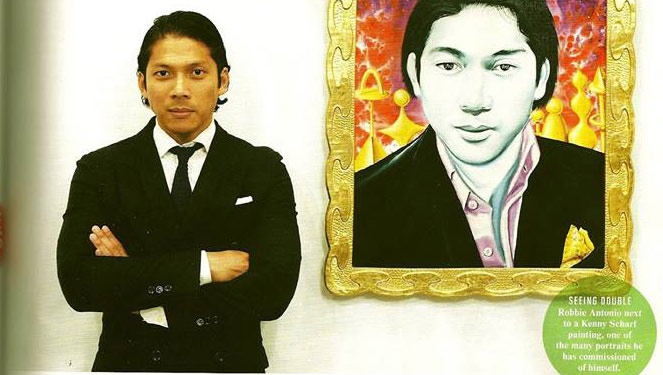
Antonio calls the second project Obsession: a series of portraits of himself by some of the world’s top contemporary artists, including Julian Schnabel, Marilyn Minter, David Salle, Zhang Huan, members of the Bruce High Quality Foundation, and Takashi Murakami.
So far, two dozen portraits are under way or completed, with nearly $3 million spent on them. Antonio is aiming for 35 in the series by the end of the year, all of which will be housed in a special gallery within Stealth, open only to invited guests. The level of effort he’s put into Obsession and Stealth over the last two years “tells you about my personality—going to extremes, down to the minutest detail,” he says.
The performance artist Marina Abramović, a friend of Antonio’s, who has called him a “volcanic tornado,” is contributing a piece to Obsession that she calls The Chamber of Stillness: a basement room in Stealth with a waterfall view that could actually lock him in for periods of up to 60 minutes and force contemplation. “She thinks I’m super-fast and need to calm down,” says Antonio.
One day in New York this winter, while riding in a town car to Chelsea to see the contents of his art-storage unit, Antonio said out of the blue, “I want to work with five Pritzker winners by the time I’m 45,” referring to the prize awarded annually by the Chicago hotel and real-estate family and the highest honor for architects. In fact, before he gave Koolhaas the green light, he says, he had discussions with the offices of Jean Nouvel, Thom Mayne, and Zaha Hadid, a murderers’ row of Pritzker laureates.
Antonio doesn’t come from a family of collectors. He’s self-educated in the arts and says simply, “I’ve always been interested in art and architecture.” But he thinks in terms of the collecting big leagues. “You see Peter Brant do this for Stephanie Seymour,” he says of his multiple portrait commissions, “but I do it for myself! I want to surpass that.”
The fortune for this unchained ambition comes from Century Properties, the publicly traded real-estate company founded by Antonio’s father, currently valued at around a half-billion dollars, according to Antonio, who manages the day-to-day operations. Most of their projects are in Asia, but Antonio also founded a separate, New York-based company to do developments there—including a collaboration with I. M. Pei on a luxury condominium, the Centurion. The family’s wealth is estimated at $300 million.
Antonio is constantly on the hunt for new Obsession commissions. In March, at New York’s Art Dealers Association of America Art Show at the Park Avenue Armory, he saw a display of Karen Kilimnik’s storybook-style portraits of women. “Does she do men?” he asked the gallery representative. (Kilimnik has not yet been drafted for the Obsession project.)
The artists he has enlisted in this quest seem bemused by Antonio’s aggressive approach but powerless to resist it. “His enthusiasm for all kinds of things is endearing—he kind of pulls you into his orbit,” says painter David Salle, who did a double portrait of Antonio next to Stealth, putting the lord alongside his manor, an updated riff on the Gainsboroughs and Sargents of old.
The Los Angeles-based painter Kenny Scharf portrayed Antonio as “a chic space alien,” (pic on top of the post)
complete with antennae. “We had dinner, I took his picture, and we talked a lot,” says Scharf of getting to know Antonio. “He wanted it immediately, and I told him he couldn’t have it immediately. He was very impatient.
“He’s a good-looking guy, and he obviously likes that part about himself.”
One thing that has helped persuade the artists to participate—beyond the $50,000 to $100,000 that Antonio is paying for each piece—is that he has done his homework. Photographer David LaChapelle recalls that, when Antonio showed up for their first meeting in Los Angeles, “he had a book of mine with literally thousands of Post-it notes.” Two months later, LaChapelle photographed Antonio against a flamboyant “millionaire’s pinball machine” backdrop.
LaChapelle takes pains to put the Obsession series in perspective. “The tradition of wealthy people wanting portraits of themselves goes back as far as art history,” he says. “It’s very easy for people to criticize him, but the more art, the better. It will be up to him to have a well-rounded project and not just a vanity project. And the collection will set him apart.”
Perhaps. Certainly having a Koolhaas house-museum is a distinction that few can claim. Plenty of people have tried to commission a Koolhaas home, but he says he was waiting for the right client—and the perfect project. “We were desperate to do more houses,” he says. “It is particularly exciting because, if you do a house, inevitably you have to engage with a person. So nothing more intimate exists.”
Somehow, Antonio’s hyper-specificity about what he wanted struck a chord. “Actually, I’m surprised they never kicked me out of their office, because I gave them, like, 50,000 images of what not to do and what to do,” says Antonio.
“Half of them were contradictory to each other,” says Koolhaas of the requested features. “Then we decided to basically not be our normal, occasionally dogmatic self but to completely adopt his point of view and see where it would end.”
Even Antonio’s architectural references were outsize. When it came to the 25,000-square-foot Stealth, he and Koolhaas used the floor plans of the Whitney and the Guggenheim as comparisons.
“It’s an enormous vision,” adds Koolhaas. “We’ve never had somebody with so many things he liked, so many things he wanted.” Originally, Antonio wanted Koolhaas to design a revolving building that would rotate a few times a month. “But I thought that would be detrimental to my budget,” Antonio says. Perhaps the most fantastical element in the finished house is near the bar on the first floor: a circular section of the wall behind it can actually flip open, hinging at the top and leading out onto the garden—giving new meaning to the phrase “man cave.”
Most of all, it was the distinctness of the Obsession project that appealed to Koolhaas, who notes dryly that “in every suburban house you see a Richard Prince Nurse.” Koolhaas says he was attracted by the notion that Antonio was testing “how far you can take patronage, or how far you can get art to represent yourself, or how you can [make] your own reputation through art.”
That was the only vote of confidence the collector needed. “I really went for it,” Antonio adds.
Rest of the art here:
By the Bruce High Quality Foundation.
By Damien Hirst (I’m disappointed that this isn’t a tank of formaldehyde for Robbie to dip himself into when he feels like doing some ~performance art~)
By Takashi Murakami.
By Zhang Huan.
By Julian Opie.
By Julian Schnabel
By Giles Bensimon